
In contemporary, thriving restaurants, success is not solely attributed to the quality of meals but also to the manner in which they are presented. Traditional laminated menus are increasingly viewed as outdated and burdensome. Restaurant owners who have not yet adopted modern menu solutions may be experiencing missed revenue opportunities.
Digital menu boards are no longer exclusive to large chains; they serve as visual, dynamic displays for menus, promotions, and brand narratives. Whether operating a single quick-service restaurant or managing multiple locations, investing in digital menu boards is a strategic decision. This document examines the limitations of static menus, the sales impact of digital signage, and the essential components of an effective digital menu strategy.
The Problem With Static Menus in Modern Restaurants
Printed menus are increasingly considered outdated in modern restaurant operations.
When ingredient costs fluctuate, restaurants relying on printed menus face two unfavorable options: absorb the financial loss or incur the expense of reprinting. Additionally, promoting special or seasonal items becomes cumbersome. Customers confronted with extensive static menus may experience decision fatigue, as there is little guidance toward featured or high-margin items.
Many restaurant owners underestimate the cumulative operational expenses associated with printed menus. Each price adjustment, menu addition, or seasonal change necessitates a cycle of redesign, printing, distribution, and replacement. Repeating this process across multiple locations results in significant material expenditures that may quickly become outdated.
A more significant opportunity cost arises from the inability to visually showcase menu items. Research indicates that customers are more likely to make purchases when they can see appealing food images, especially on high-definition screens positioned above the counter. Printed menus cannot match the persuasive impact of dynamic visual displays.
Flexibility is another critical consideration. The restaurant needs to shift throughout the day, from breakfast to late-night service. Printed menus lack the adaptability needed to respond to these changes, resulting in inefficiencies that are particularly costly in an industry with narrow profit margins.
What Are Digital Menu Boards and How Do They Work?
A Digital Menu Board is a display screen at your counter, entrance, or waiting area that provides a visually rich, dynamically updated display of your menu, promotions, and brand content.
It’s not as complicated as most restaurant owners think. It only requires a screen, a media player, and a cloud-based content management platform such as Disploy. After installation, you can edit your menu, pricing, or promotions from anywhere, your phone, laptop, or tablet, and it is reflected in your screens within minutes. No technician required, no downtime, and no reprinting. Disploy also works on various display hardware, such as Samsung, Android, and LG screens, meaning most restaurants do not have to replace anything.
Do Digital Menu Boards Actually Increase Restaurant Sales?
Empirical data support the assertion that digital menu boards increase restaurant sales.
Research in the digital signage space shows a 3-8% increase in average order value, with some restaurants achieving higher gains at specific promotional times. The right content at the right time leads to a significant rise in impulse purchases, add-on drinks, desserts, and combo upgrades.
The following mechanisms illustrate how digital menu boards drive sales:
Upselling Through Visual Storytelling
There is a fundamental distinction between reading about Paneer Tikka with a listed price and viewing a visually engaging, high-quality image or video of the dish on a digital screen. The former conveys information, while the latter stimulates desire.
Digital menu boards, unlike printed menus, can present food in an appealing and enticing way. High-quality graphics elicit emotional and instinctive responses, influencing customer choices. When a screen displays a visually attractive combo meal with a beverage, customers are more likely to consider and purchase both items.
Promotional banners here can also work wonders. You will get far more attention if you put up a deal that pops up for 10 seconds every minute, rather than a small printout in a corner of your board. It feels urgent. It feels relevant. And it converts.
Real-Time Promotions and Dayparting
One of the least-leveraged features of restaurant digital signage is dayparting, which allows you to show different content at different times of day. Your breakfast menu is on now at 8 AM. It changes to lunch at 11:30. Dinner content begins at 6 PM. No manual input, no reminders from staff, and no risk of displaying the incorrect menu at the wrong time.
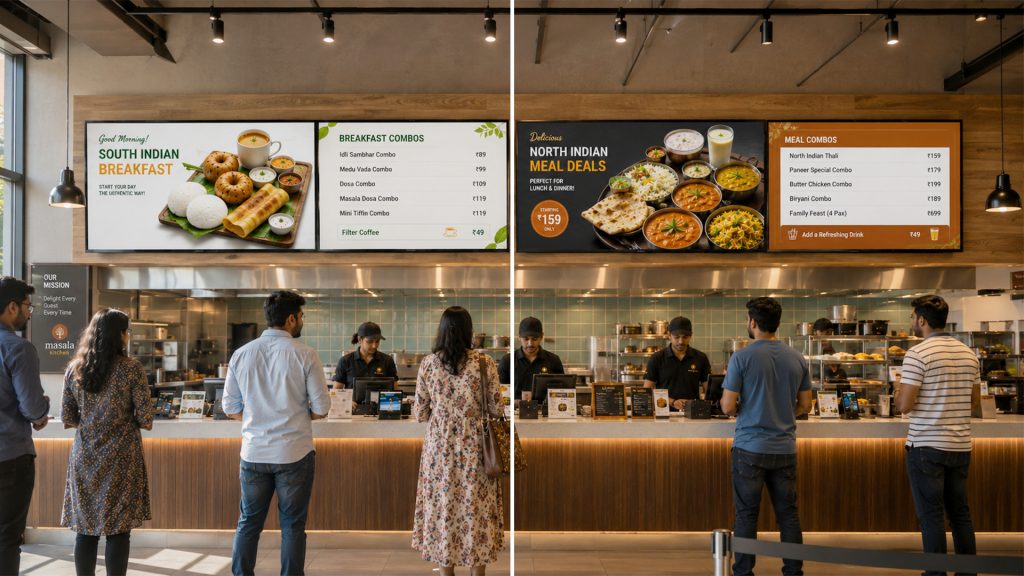
In addition to the scheduled content, you could also push flash deals during low-traffic times, offer a discount on slow-moving stock, run a happy-hour promotion, offer a limited-time combo, and have it go live on all screens within minutes. Such flexibility can’t be achieved with printed menus, and it’s exactly what helps restaurants stay profitable in a competitive environment.
This is about menu psychology and strategic item placement
Menu Psychology and Strategic Item Placement
The where matters just as much as the what. Where an item appears on your digital menu boards, how large it’s displayed, whether it has a visual, and whether it appears in a highlighted frame, directly influence what customers order.
Items on a screen that have high margins have a higher percentage of orders. It is not manipulation; it is smart design. Physically printed menus can’t be updated monthly to reflect your current priorities. Digital boards can. Serve one dish for a fortnight, check out the sales figures, and modify. Such a merchandising approach was seen only in large restaurant groups with their own marketing departments. Now it can be accessed by any restaurant on the right platform.
How Sankalp Restaurants Transformed Their Screens Using Disploy
Sankalp is one of India’s largest restaurant chains, offering authentic South Indian food in 7 countries. As the brand expanded its pan-India network, in-store display management was becoming a real challenge. Content was updated via pen drives, requiring staff to physically go to each screen at each location to plug in the updates. This was neither scalable nor efficient, as there were multiple screens across multiple cities. It was impossible to guarantee consistency, and any error would require the whole print-and-replace process to begin anew.
But once they transferred to Disploy, everything did change. Previously, a few hours of coordination across locations could now be accomplished in just a few minutes from a single dashboard. Desktops and laptops no longer contain pen drives. Reprinting is gone. Any change, new dish, new price, or festive special is pushed live instantly on all screens. Just as the Operations Team at Sankalp said, “We do the change once, and it’s done everywhere. It has really saved us time, money, and a lot of needless back-and-forth.
The Full Benefits of Digital Menu Boards for Restaurants
The numbers are in the sales column, but owners who have made the cut often also believe in the operational and brand advantages.
Brand Consistency Across Locations
If you have more than one outlet, you’re familiar with the challenge: menus change. One site has a promotion that the other is unaware of. A product is found in one location, but not the other. Staff make their own price list and tape it over the existing price list. It’s a nightmare for brand consistency, which is remarkably difficult to correct in the printed product.
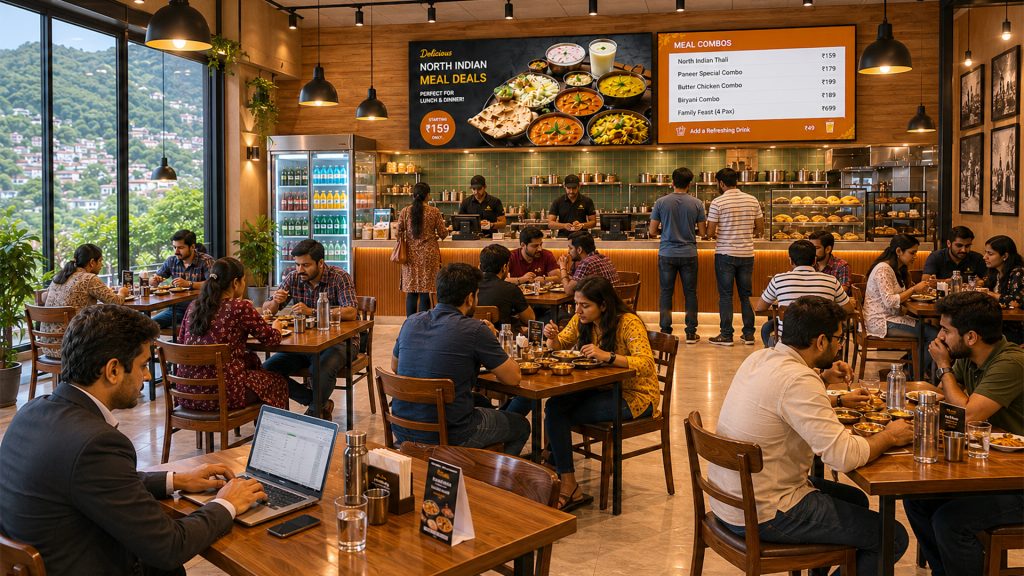
Centralized restaurant digital signage technology allows you to manage the content displayed on all screens from a single location across multiple locations. A change, that’s an instant everywhere. Whether it’s the main branch or a new branch location, the customer experience is intentional and professional.
Reducing Perceived Wait Time
No one wants to wait for their order. However, research has found that consumers perceive shorter wait times when they are engaged in some way during this period. Whether it’s fun content, a behind-the-scenes view of your kitchen, your sourcing journey, or a visual breakdown of your best-selling items, the digital screen keeps customers entertained and, most importantly, helps keep your brand fresh in their minds.
This is a non-expensive affair. It’s a relatively simple thing to make the wait more meaningful by adding well-designed content to existing screens.
Operational Efficiency
Your staff’s time is better spent serving customers, which they could be doing had they not had to manage printed menus, update price stickers, remove discontinued items, and explain specials that have run out. This is nearly eliminated with digital menu boards. Prices can change in seconds. Items that are sold out are taken off with a tap. New additions are immediately available.
The reprint savings are enough to make the investment worthwhile for many restaurants within the first year.
Sustainability
While not an immediate concern for a restaurant owner, it’s becoming more important for many, particularly younger customers. So getting rid of printed menu waste is a real sustainable achievement. It’s also a story you should be sharing on your signage, social media, and talking about your brand. Thoughtful restaurants bring in customers who appreciate the same things.
How Taranovas Pizza Upgraded Their In-Store Experience Using Disploy
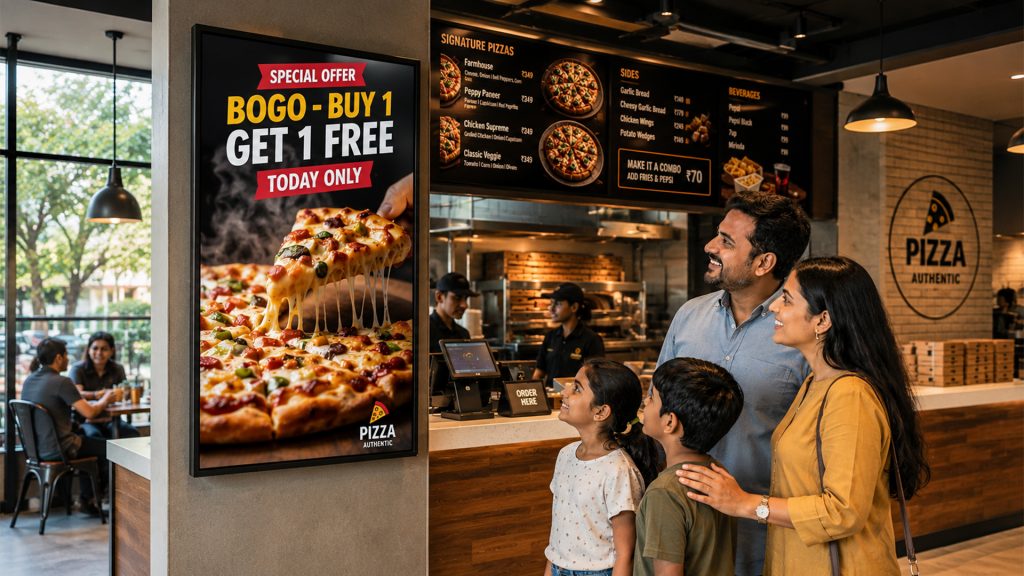
Taranovas Pizza is a true Italian pizzeria in Ahmedabad, Gujarat, serving signature pizzas such as Romano Cheese, Turkish Blaster, and Bologna Bites. Their current food catalogs and leaflets were causing friction at every touchpoint, especially given a fast-changing menu and time-sensitive offers such as BOGO deals.
Each menu change involved redesign, reprint, and physical changes to materials. The availability of offers such as buy-one-get-one-free was just too late to prompt customer action. There was no scalable way forward with the old approach, and expansion was planned in Jaipur and Columbus, USA.
But, all that changed after the deployment of Disploy. Promotional offers like BOGO deals couldn’t go live quickly enough to actually drive customer action. Previously, hours were spent updating menus; now, minutes. The cost of reprinting has been completely eliminated. And as they expand their footprint, Disploy’s multi-location management enables each new outlet to be onboarded and centrally managed from day one without the need for complex setups.
Taranovas Management Team said, “Whatever it may be, from introducing a new pizza release to a BOGO deal, a last-minute price change, updating our digital menu boards is a few clicks away with Disploy”.
What Makes a Digital Menu Board Strategy Actually Work
This is what most restaurants lack. They set up the screens. They upload a menu. They feel that the work is finished.
It isn’t. The screen is simply the canvas. The strategy is what you put on it, where you put it, and how often you update it. It’s the strategy that makes the difference between restaurants that make it and those that simply have nice-looking screens.
Content is King: What to Display and When
Low-quality images are worse than no images at all. A poor photo of your dish with poor lighting does more harm to your brand than a clean text listing. When it comes to investing in digital signage, don’t forget to invest in the content that’s displayed. For smaller eateries, a smartphone photo taken in good natural light is enough. Professional food photography may be an excellent investment for top-tier positioning.
Try to consider the content mix besides food visuals. But it shouldn’t be all promotions; it’s like a sales pitch, and customers tune that out. Add some “brand storytelling”: your origin story, your sourcing philosophy, your chef’s picks. Content that supports connection and content that drives orders is a combination that will win. Content is updated seasonally and on events, to keep it fresh and relevant. October screenings of Diwali specials or July screenings of monsoon comfort food are appropriate. They demonstrate your brand’s vitality and responsiveness.
Placement and Screen Positioning
The purpose of a screen is not the same for all screens and should therefore be considered when placing one.
The mood was set at the entry point with screens. They are screen branding tools that help you highlight your atmosphere, specialties, and current highlights. There should not be many menus on them.
Decision-making screens are screens at the ordering counter. It’s important to have a simple menu with graphics for featured and high-margin items. Upsell prompts and combo suggestions go here.
Waiting area screens are a different story. Once an order is placed, it is not helpful to remind a customer of the menu. Please give them something that helps them connect with your brand, such as a story about a dish, a quick video of your kitchen, or a highlight of your loyalty program.
Eye-level screens are always superior to overhead-mounted screens for influencing at-counter decisions. If it is possible to be flexible, still reserve the most important content for where eyes will naturally go.
Keeping Content Fresh
If a screen is displaying the same material as it did 3 months ago, it is a problem. While it may not be obvious to your customers, when your content is the same, they make a silent statement that your brand isn’t paying attention, thereby creating an impression. This is not what you want.
Create a realistic content refresh plan. Just a monthly change, a new dish for the season, with a new combination, and some fresh graphics can keep things up to date. Disploy has been designed to make this a breeze, and it requires no designer or technical knowledge. You can handle it without hassle, all the time, without your team getting in the way.
How to Choose the Right Digital Signage Partner for Your Restaurant
The technology is just one component of the equation. The selection of the partner also plays an important role.
Ease of use: When your team requires a tech expert to make regular updates, the system is more of a problem than a help. Search for a platform that has an easy-to-use dashboard that all the staff can use with confidence.
Remote management: The ability to update all your screens from anywhere, your home, your head office, your phone, is non-negotiable. If a content change requires a physical visit to each location, the platform isn’t fit for purpose.
Hardware compatibility: When software needs to be changed, it’s a waste of money to replace all screens. A good platform is compatible with the devices you already have: Samsung, Android, LG, and more.
Reliable support: Dark screens during the Friday evening rush are a possibility. If something goes wrong, your signage partner must be supportive and have escalation plans in place.
Scalability: It should be scalable; if it is your second location or your tenth, you shouldn’t need a complete system overhaul. Disploy’s multi-location management is purpose-built for this; new outlets can be onboarded and managed centrally from the get-go, as Taranovas now will for their Jaipur and USA expansions.
It’s Time to Let Your Menu Work as Hard as Your Kitchen Does
The restaurants with a head start now aren’t necessarily doing anything so different from their competition. They are making smarter decisions about presentation, flexibility, and in-store experience, and digital menu boards play a key role in this shift.
Static menus limit you. They fix your price, limit your offers, and turn your food into text on a printed page! Every day that you don’t make something different is a disadvantage you’re taking.
Sankalp operates a multi-location network of screens, and now their team can update all screens from one dashboard in minutes. Taranovas Pizza offers time-sensitive BOGO deals that activate on the spot and require no coordination overhead. These are not enterprise-level brands that have enterprise-level budgets. They are restaurants that took one good business move and are doing well because of it.
If you’re ready to put an end to reprinting, lost promotions, and showing your restaurant the way it deserves to be shown, Disploy is designed for you. Get in touch with Disploy and transform your restaurant’s in-store experience. No complicated setup. No hardware overhaul. Your menu, your promotions, and your brand, updated in seconds from anywhere, on every screen.