
You enter your office on Monday morning, and instead of dusty bulletin boards with outdated announcements, you meet bright, moving screens with real-time company updates, weather forecasts, and motivating messages. It is not a futuristic dream but the reality of digital signage in contemporary workspaces. The old bulletin board and the static posters that previously covered the office walls are a thing of the past, replaced by sleek digital office signage that is changing the way businesses communicate, engage, and conduct business.
Digital signage is an innovative advancement in workplace communication technology. These smart display signages are much more than plain screens showing mere information. They are very powerful tools that can display live data feeds, interactive content, emergency alerts, and customized messages that change based on the time of day or the target audience. From small-scale businesses to major corporations, organizations across all sectors are finding that digital signage is not merely a cool enhancement, but an important aspect of managing the workplace.
The advantages are much more than aesthetic, although the visual pleasure is admitted. Contemporary employees desire to see the same level of technological advancement in their work-based settings as they do in their personal lives. The failure of workplaces to embrace modern communication tools can affect areas such as employee satisfaction and employee recruitment. Digital signage can fill this gap by creating an atmosphere of modernity, professionalism, and innovation, and addressing very real communication issues that afflict many organizations.
Internal Communication and Information Flow Revolution
Office-based conventional communication methods tend to cause bottlenecks and missed opportunities for interconnection. Whilst in a long email, how many times have you noticed key announcements at the bottom of the email that never got read by any employee? Or saw vital information lost in the mess of day-to-day business? Digital signage eliminates such frequent communication breakdowns by providing an information center where all information is centrally located and naturally catches the eye.
These systems are good at presenting information in easy-to-understand, attractive forms that are easy to remember. Employees do not have to scroll through dozens of emails to find the relevant updates; instead, at specific points during their workdays, they can look at strategically placed screens to stay informed. Automatic updating of the content is possible, and thus the information is always up to date and correct. Real-time updates on weather, traffic conditions, company, project milestones, and upcoming deadlines can be made at any time, thereby creating an educated workforce that is in touch with what goes on within the company as well as outside the company and that, in turn, influences their work.
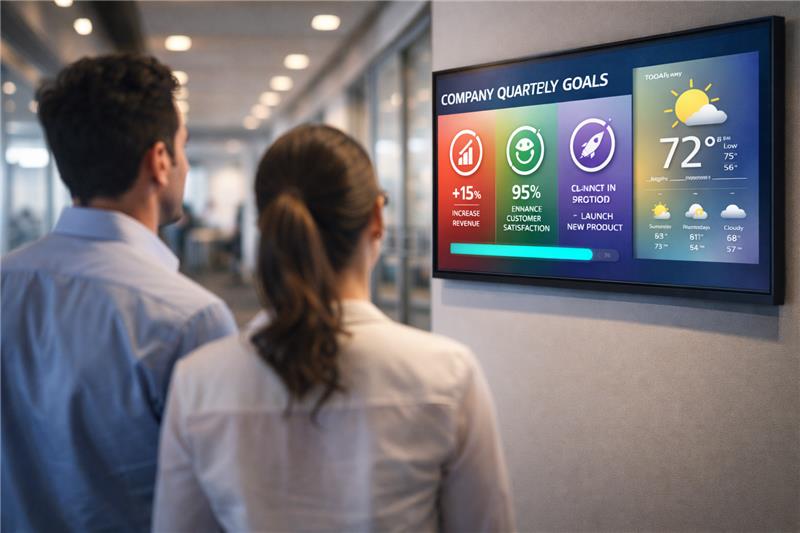
Digital signage is great because it can divide content based on what viewers see and where they are in the same building. The reception areas may have welcoming messages to visitors and general company details. The break rooms may have social content, employee appreciation, and upcoming events. Meeting schedules and room availability could be shown automatically in conference rooms, and safety reminders and performance metrics could be prioritized in production floors. This focus will help make every communication activity as effective as possible by delivering the right information to the right people at the right time.
In addition, office digital signage enables two-way communication, which is not available with traditional methods. Interactive screens will be able to receive feedback, conduct rapid surveys, or enable employees to share suggestions and impressions via touch-screen interfaces. This direct feedback mechanism helps management stay in touch with employees’ needs and concerns and fosters a culture of open communication and continuous improvement.
Increasing Employee Engagement and Company Culture
In the modern, diverse, and, in many cases, remote-friendly workplace, developing a strong company culture is a challenge in itself. Office Digital signage is an effective tool for fostering and sustaining cultural ties by providing channels for employee appreciation, social communication, and community-building programs to unite the staff around common values and accomplishments.
Rewards programs for employees are much more effective when rewards are displayed publicly using digital displays. Digital signage can be used instead of recognition confined to email notifications or small group gatherings, where the companies demonstrate employee achievements, work anniversaries, and individual accomplishments, in high-traffic areas that everyone can view and share. This is not only recognition by the public that makes the honored employee feel important, but also provides others with a sense of motivation and strengthens the behaviors and accomplishments the company cherishes most.

Office digital signage creates social content. It makes the workplace more human and creates personal bonds between team members. Company event photo galleries, employee hobby displays, family gatherings, and volunteerism provide a source of conversation and help employees discover what they have in common with their teammates. Such personal touches can be particularly helpful in a larger organization, where they may not otherwise occur. Silos can be broken down, and a logical workplace community can be formed.
Office digital signage is also ideal in supporting the company’s initiatives and campaigns due to its dynamic nature. Office digital signage can remind employees of the initiative every time by showing progress, sustainability, diversity, or charitable fundraising efforts, whether it is a reminder or an update, keeping the initiative in mind. Interactive features may enable workers to enroll in events, track progress, or contribute personally to the company-wide action, making them feel part of the whole.
Moreover, office digital signage should be used to overcome generational gaps in the workplace, as information can be delivered in formats that appeal to diverse learning styles and preferences. Infographics and video materials are helpful to visual learners. A scan of bullet points or headlines may help those who prefer to be informed more quickly. This communication strategy makes every employee feel included, irrespective of their communication style or comfort level with technology, and helps them remain attentive and up to date.
Improving Professional Image and Visitor Experience
First impressions are very important in business. When you have guests in your office, they start judging your business on professionalism, innovation, and attention to detail. Digital waiting bays and communal spaces tell you at a glance that your organization has adopted modern technology and invested in creating positive experiences for both its employees and guests.
Professional digital screens showcase the company’s accomplishments, principles, and services through smooth, vibrant presentations that cannot be achieved with other media. The testimonials from clients, project portfolios, awards and recognition, and company milestones can be enhanced with captivating visual images that bolster the credibility and success of your organization. It is a small form of marketing that helps visitors learn more about your company and what you are good at, and it does not require a specific number of staff to be allocated to making presentations and explanations.
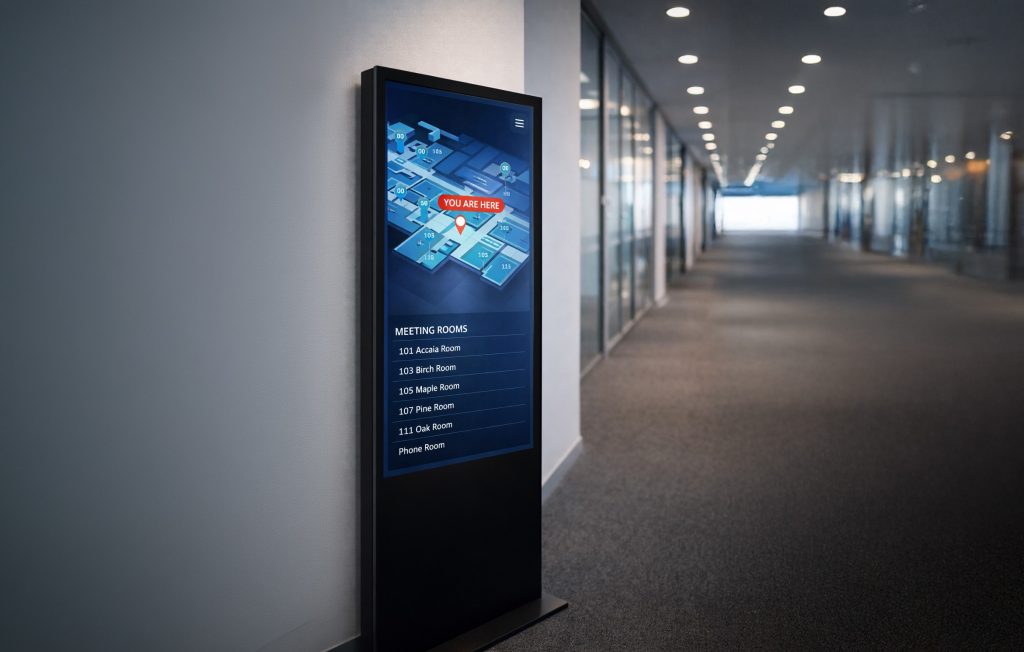
The wayfinding features of digital signage are also very important for enhancing visitor experiences in larger or more complex offices. Interactive directories would be beneficial in helping guests find specific departments, meeting rooms, or people quickly and independently. Online announcements can guide visitors in the event of changes to meeting points or notify them of delays. This self-service will help customers be less frustrated, and the reception team can concentrate on other, more complex services for guests and administrative work.
Environmental responsibility is also demonstrated through the use of digital signage, which reduces paper use and waste. Companies do not have to print new flyers, posters, and announcements, thereby creating a lot of physical waste on a regular basis, since digital information can be updated immediately. This eco-friendly solution will attract green-conscious clients, employees, and partners and minimize the current printing and materials expenditures. The freedom to modify content also implies that seasonal decorations, holiday messages, and event promotion can be automated, keeping office displays up to date and in good shape.
Besides, office digital signage offers flexibility and adaptability to different languages, accessibility needs, and cultural factors, working with various clients or international collaborators. Cultural awareness and inclusiveness can help the business bond with its visitors by adapting or translating its content to meet the needs of specific visitors as quickly as possible.
Smartening Operations and Making Things Lean
In addition to communication and aesthetics, office digital signage is an influential tool that can streamline many workflows and make the overall process more effective. The capability for real-time integration enables such systems to display real-time information from different business applications and create centralized dashboards that help teams monitor their performance, track their goals, and detect issues faster.
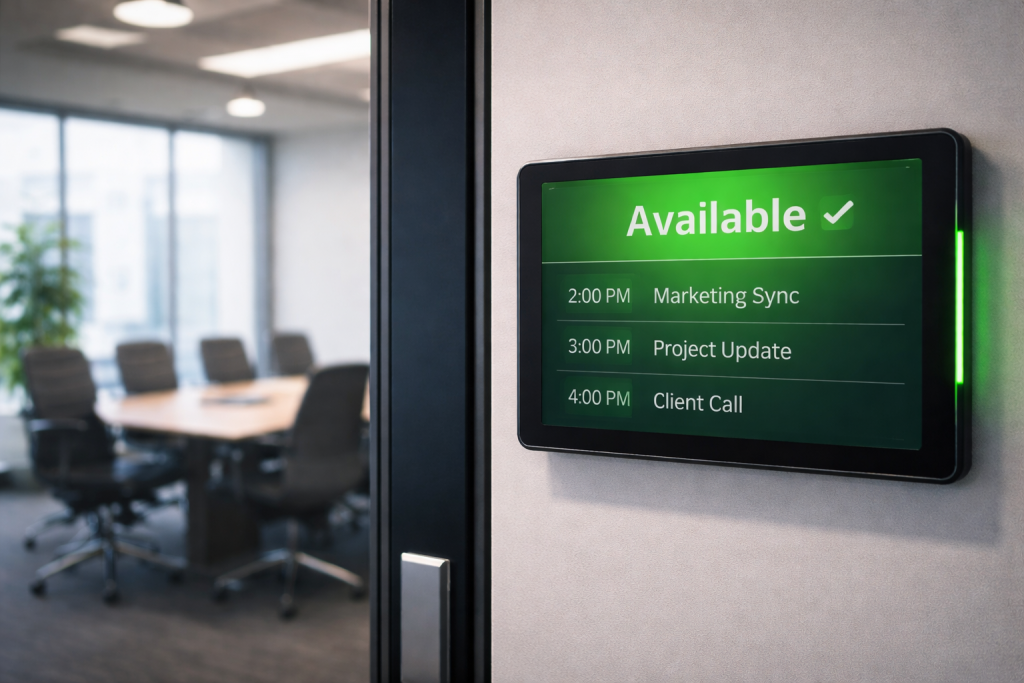
The management of meeting rooms is greatly enhanced by implementing digital displays outside the conference rooms, where real-time availability, current bookings, and future schedules can be viewed. The employees can, at a glance, see which rooms are available for impromptu meetings and which are in use and will become free at that time. Some systems enable on-the-spot booking using touch-screen interfaces. In such systems, there is no need to go back to desks or call administrative staff to reserve space. This is a lean process that minimizes meeting time lags and maximizes the use of available conference space.
Another important operational advantage of office digital signage systems is emergency communication. In instances where the weather is unfriendly, there are security conditions, or other emergency scenarios, office digital signage can immediately broadcast vital safety information, evacuation guidelines, or status updates across the entire plant. This fast communication potential is literally life-saving, and it is also used to preserve sanity and reduce panic in stressful situations. These systems are centrally controlled, which means emergency messages can be issued instantly from a single point and information is uniformly distributed to all regions at once.
Office digital signage also improves operational efficiency by saving time and resources used in normal communication processes. Administrative messages, policy updates, training messages, and HR announcements can be set up and automatically activated, freeing human resources for other, more strategic tasks. Being able to deliver content to specific places or groups of employees implies that message overload does not fill screens; instead, the message is specific and actionable for individual audiences.
Investment: ROI and Implementation
Although the advantages of office digital signage are strong, it is necessary to carefully plan and consider several issues when implementing it, such as budget, technical considerations, content management, and long-term maintenance. Knowledge of the total cost of ownership and potential return on investment helps organizations make effective decisions about their office digital signage approach.
The first cost of office digital signage is usually the hardware (displays, media players, mounting equipment) and software license (content management systems and technical support) costs. Nevertheless, in most organizations, such initial expenses are recouped within a relatively short period through savings in printing, materials, and labor associated with traditional means of communication. Moreover, higher efficiency & employee involvement usually translate into quantifiable productivity gains that pay off.
Content production and management are ongoing challenges that can profoundly affect the success of digital signage projects. Companies should assign the responsibility for developing, updating, and maintaining content so that displays are up to date, relevant, and interesting to visitors. There are companies that prefer to do this in-house, and others that engage specialized agencies or freelance writers to produce professional content. The trick is to build sustainable procedures that will make signage not stagnant and useless, but digital manifestations of forgotten bulletin boards.
Technical factors encompass the need for network infrastructure, the display’s placement so it can be seen and make the most impact, and its integration with current business systems. Engaging long-time vendors and installers will help ensure that the systems are correctly set up, safe, and can be expanded later on when the company may need them. Systems should also be maintained and updated regularly to ensure they operate smoothly and maintain a professional look.
Conclusion
It is not about whether office digital signage will be the new order of the day in the modern workplace, but rather how quickly progressive organizations will adopt the technology to gain competitive advantages in communication, culture, and operational efficiency. Business firms that still rely solely on classical communication systems will lag in employee engagement, business performance, and professional reputation.
Digital signage is not merely a technical upgrade. It is an investment in dynamic, interactive, and efficient work environments that attract and retain top talent and enhance a business’s overall performance. Office digital signage is key to success in the modern, competitive business environment, as it allows creating an immediate impression on every worker, simplifying workflows, and enhancing the company culture.
With cost reductions ongoing and technology becoming even more advanced, the obstacle to implementing digital signage continues to diminish, with the benefits becoming more pronounced. Those who do it now become founder organizations and gain direct benefits in communication effectiveness and workplace attractiveness. The current environment requires modern solutions, and office digital signage can deliver results that cannot be matched by old-fashioned approaches.
It is high time that you changed your workplace communication. Your workers, guests, and the bottom line will be grateful to you for investing in office digital signage technology that takes your office space to the next level. Are you the one to put this vision into your office? The technical obstacles should not be the reason you don’t modernize your workspace. View the ability of the office digital signage with Disploy and get a risk-free trial. You need to increase employee engagement or simplify your internal communications. With our platform, it is easy to create and publish content within minutes.