
According to research, a patient spends an average of 8 to 20 minutes in the clinic waiting room. To this day, the clinic waiting room is ruled by out-of-date magazines, old televisions, or a tower of brochures no one checks. Nowadays, more and more clinics are replacing that passive experience with dental digital signage that delivers bite-sized videos, oral health tips, and even live social media feeds.
Clinics that adopted these dental digital signage systems have an impressive story to share: If we use dental digital signage intelligently, it can actually triple patient engagement, both in terms of treatment inquiries and post-visit reviews. In this article, we will discuss the reasons behind that, how to establish an efficient screening strategy, and what pitfalls to avoid.
What is Dental Digital Signage?
Dental Digital Signage refers to the usage of screens in dentistry to display dynamic content such as educational videos, promotions, and entertainment. It enhances patient experience by reducing perceived wait times, educating on oral health, and building trust in the practice
The Evolution of the Dental Waiting Room
A Brief Look Back
- Pre-digital: Flyers, posters, and a few VHS slideshows.
- Cable TV era: Generic programming, minimal or no dental interest.
- Interactive age: Tablets on the counter, but not that visible.
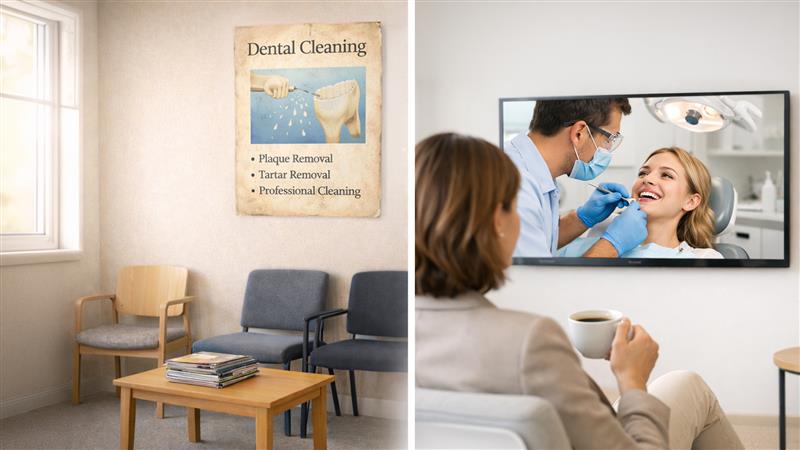
Waiting-room design has continually sought to rebalance education with comfort, but paper collateral has rarely been a topic of discussion. Patients either overlooked it or read it superficially. By combining sharp motion graphics and timely messaging, it alters that equation in favor of digital signage.
“Patients who viewed our custom videos asked 2.7 times more questions about preventive care.” – Dr. Marisa Lopez, Riverbend Family Dental (anecdotal practice survey, 2023)
What Does “Patient Engagement” Mean in Dentistry?
- Treatment acceptance: Appointment for prescribed services, such as whitening or sealants.
- Compliance with appointment: Reduced no-show and improved punctual attendance.
- Online communication: scanning a QR code, leaving an online review, or following the practice on social media.
- Conversation with staff: Questions about procedures, insurance, or after-care.
According to industry statistics from the American Dental Association (ADA), an annual revenue increase of about 10% can be achieved for each 5% increase in treatment acceptance in a mid-size practice. Participation, in turn, is not a nice-to-have; it directly influences the outcomes of clinical practice and business sustainability.
Why Static Posters Fail, and Screens Succeed
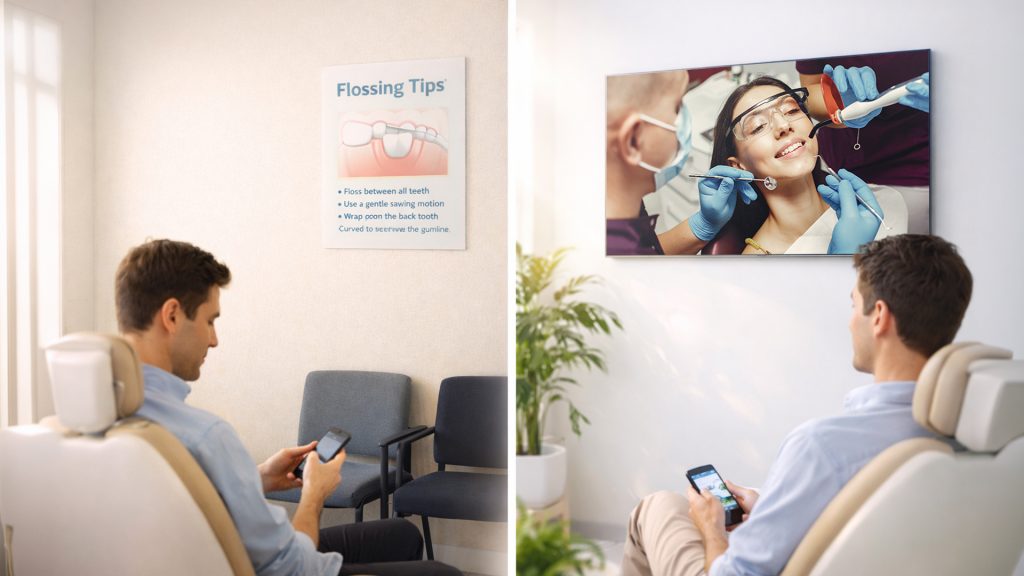
Scientific Visual Attention.
- Movement draws attention: our minds are pre-programmed to perceive movement.
- Fresh is better than tired: Digital slides change every 10 to 15 seconds, eliminating banner blindness.
- Contextual relevance: Schedule content by daypart; offer hygiene tips for kids in the after-school slot; implement education in the morning, etc.
In a Nielsen study of digital signage (2021), recall rates of 52% were found compared to 23% of posters, more than twice the likelihood that a patient will recall the important messages.
Three Ways Digital Signage Boosts Engagement
1. Real-Time Education
Short animations of brushing angles, floss threading, or the advantages of fluoride are displayed on screens. Rather than being instructed by a dentist at the chairside, a patient comes to the operating room with already questions in mind.
- Animated sequences hold attention longer than text.
- Memory is enhanced through repetition over a 10-minute loop.
- Closed captions enable access to hard-of-hearing patients.
2. Interactive Elements through QR Codes.
An effective QR code located somewhere strategic will invite the viewers to:
- Download post-operation instructions.
- Complete the new-patient paperwork and be recalled.
- Run a monthly competition to win an electric toothbrush.
“When Riverbend Family Dental added QR codes to its Invisalign segment, QR scans jumped from 8 per month to 27 per month in their Invisalign segment – a 237% increase in potential leads for clear aligners.”
3. Community Stories and Social Proof.
Patients believe peers more than promotional copy. Digital signage may be rotating:
- Pre-test-post-test slideshows (with consent).
- Short video testimonials.
- Recent charity drive or visit to schools photos.
Sharing real-life experiences fosters a sense of belonging and encourages reluctant patients to engage in prescribed therapies.
Designing Content That Resonates
Keep It Short and Personable
- Perfectly 15 to 30-second clips.
- Use simple words: cavity instead of carious lesions.
- Humanize the practice by featuring the staff members.
Make It Inclusive
- Provide subtitles in English and the prevailing local second language.
- Show various examples to ensure that no patient feels excluded.
Maintain ADA Compliance
To ensure patient comfort, avoid using flashing lights or jarring color contrasts in your dental digital signage, as these can trigger photosensitive reactions or increase anxiety. You can ensure readability with the assistance of tools like the WebAIM contrast checker
Practical Steps for Clinics Considering Digital Signage
- Evaluate space: Walk through the waiting area to find the best viewing distance and angle. Position screens at eye level for seated patients to avoid neck strain, ensuring they are visible from most seats without obstruction. Also, check the ambient lighting to minimize glare and improve the viewing experience.
- Select hardware:
- Entry-level: An HDMI media stick-equipped consumer-grade 43-inch TV.
- Mid-range: Commercial display and in-built media player.
- Premium: Interactive touch screen or video wall.
- Select a content management system (CMS): Choose basic, drag-and-drop platforms for quick staff updates. Ensure the provider offers HIPAA-compliant cloud storage to protect patient data. Prioritize features like remote multi-screen management and integrated apps for diverse, real-time content.
- Develop a content schedule: Change the content every month; new content should be related to a specific event (e.g., National Children’s Dental Health, No Smoking Day, etc.).
- Train the staff: Front-desk personnel must be aware of how to pause or update slides when a sensitive subject arises.
- Maintenance budget: Plan to spend approximately 10% of the initial expenses every year on repairs and software licenses.
Common Mistakes and How to Avoid Them
Overloading Slides
The problem of fitting all the services into a single loop overwhelms viewers. Target between three and five critical messages in a cycle.
Ignoring Audio Levels
Dim screens are dependent on captions; high-level audio may annoy nervous patients. Volume test at various seating positions.
Outdated Content
There is nothing more damaging to credibility than a Back-to-School Special still running in December. Schedule quarterly audits.
Neglecting Data Privacy
Do not show patients’ full names or appointment times. Make HIPAA first.
Measuring Success: From Impressions to Action
Key Performance Indicators (KPIs).
- Scan rate: The number of QR code scans per 100 waiting-room visits.
- Uptake of treatment: Compare pre- and post-signing acceptance.
- Feedback on the survey: Simple exit survey: Did you find the waiting-room information helpful?
Riverbend’s pilot program recorded the following over six months:
- QR code scans in the Invisalign segment increased from 162 to 506, representing an almost 212% increase.
- As patients were able to see the benefits of tooth whitening, 34 bookings increased to 92, a +171% increase.
- Through dental digital signage, patients were able to scan the Google review QR code, increasing the number of reviews from 11 to 36, resulting in a 227% increase in overall reviews.
These figures illustrate why the phrase “triples patient engagement” is more than marketing spin; it reflects measurable behavior change.
Conclusion
Digital signage will convert waiting-room minutes of idleness to a micro-learning experience. By integrating movement and interactivity with a real story, it is possible to create a practice that generates curiosity, encourages preventive behaviors, and inspires patients to take an active role in their oral health.
The action plan is simple: select the appropriate screen, create brief content, change it frequently, and monitor certain KPIs. At the end of the day, your waiting room need not be so much of a lobby as the first step in your patient’s healing process. If you are ready to make those silent minutes meaningful for your clinics, try the Disploy digital signage free trial, and you’ll see you don’t need any other complicated setups.