
A potential buyer passes your brokerage late at night. The office is closed, agents are unavailable, and the window displays feature outdated listings, including one that has already sold. The couple attempts to read the details but, unable to do so, moves on.
This is a missed lead you may never realize. Now, consider the same scenario with a digital display in your window. The screen showcases four new listings with professional photos, pricing, square footage, and a QR code for a virtual walkthrough. The couple stops to learn more.
This illustrates the impact of real estate digital signage. In an industry where timing, first impressions, and availability are critical, digital signage remains an underutilized resource.
Real Estate Never Sleeps, But Most Marketing Does
The way people buy property has changed dramatically. Buyers today do 70-80% of their research before they ever contact an agent, according to the National Association of Realtors. They browse listings at midnight, watch neighborhood walkthrough videos on lunch breaks, and make emotional decisions about homes before they’ve ever stepped inside one.
However, most brokerages still limit their marketing efforts to standard business hours.

Printed window displays go old. Flyers run out. Open houses happen once a week, if the schedule allows. Yard signs are passive and silent. None of these tools is doing anything for you when you’re not in the room.
Real estate digital signage changes that equation entirely. It’s the one tool in your marketing that works around the clock, updates automatically, and actively engages potential buyers, whether your office is buzzing with agents or sitting dark on a Sunday evening.
What Real Estate Digital Signage Actually Is
Let’s clear something up first, because digital signage isn’t just a TV on a wall playing a slideshow someone built in PowerPoint three years ago. Modern real estate digital signage is a dynamic, connected display system that can pull in live data, update automatically, run scheduled content, and serve as a fully functional visual sales tool 24 hours a day.
In a real estate context, that looks like:
- Window-facing displays that showcase current listings with photos, pricing, and QR codes to passersby, even after hours.
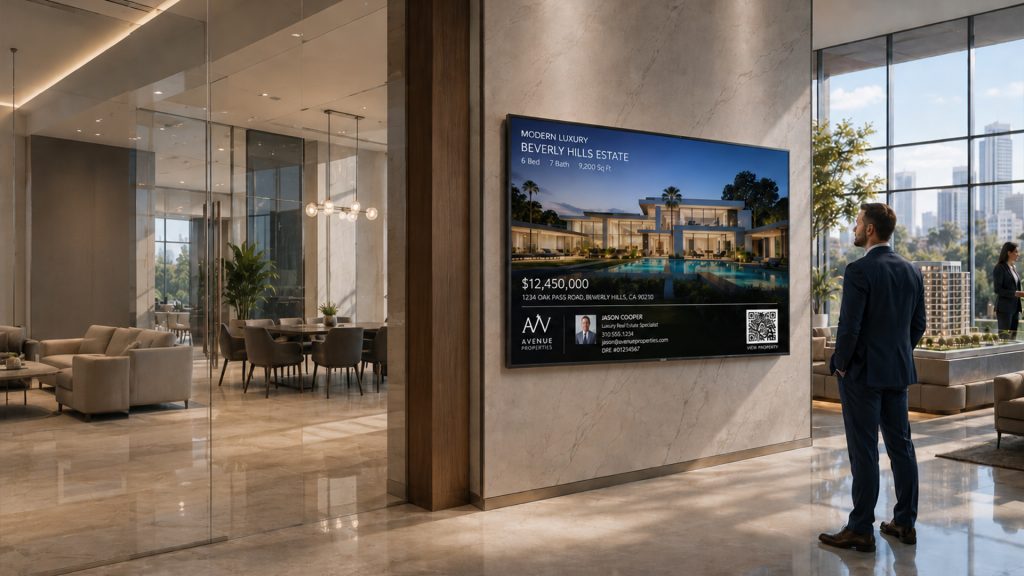
- Live MLS property feed screens that sync directly with your listing database, so the moment a property goes live, sells, or changes price, your displays update automatically. No manual work. No outdated information.
- The brokerage lobby showcases screens that greet walk-in clients with a rotating gallery of premium listings, agent profiles, market stats, and even neighborhood guides, creating a powerful first impression before a single word is spoken.
- Virtual open houses display property video walkthroughs, floor plans, and lifestyle content on a loop, letting buyers experience a listing visually without scheduling a showing.
Each of these serves a specific purpose. Together, real estate digital signage turns your physical space and your window into a sales machine that never clocks out.
The Three Use Cases That Are Changing How Brokerages Operate
1. Virtual Open Houses
Open houses are great, but they’re also expensive. They require agent time, staging, coordination, and they happen once, maybe twice, for any given listing. A virtual open house display doesn’t have those constraints.
Picture a screen in your lobby or window running a professionally produced walkthrough of a listing, room by room, with ambient music, key stats overlaid, and a neighborhood highlight reel at the end. It plays on loop. Every person who walks past your office, sits in your waiting area, or visits during off-hours gets the full experience.
Sotheby’s International Realty locations in several U.S. markets have integrated lobby display screens that run exactly this kind of content for their luxury listings. The result isn’t just aesthetics; agents report that clients who’ve seen the lobby displays arrive at actual showings significantly more prepared, more emotionally connected to properties, and closer to a buying decision. The screens do the early-stage selling.
2. Live MLS Property Feeds
Nothing kills buyer trust faster than outdated information. A listing displayed in your window that sold six weeks ago doesn’t just waste their time; it signals that you’re not paying attention.
Live MLS-integrated real estate digital signage solves this completely. When your displays pull directly from your MLS feed, every price change, new listing, and status update reflects automatically on your screens. You set it up once, and it stays up to date forever.
A mid-size brokerage in Austin, Texas, operating across four office locations, implemented MLS-connected displays in 2023. Within the first two months, walk-in inquiries at their busiest branch increased by 31%. The reason, according to their office manager, is that people walking past started stopping to look at the screens because the listings were clearly fresh, clearly local, and clearly worth paying attention to. The window had become a destination.
3. Brokerage Lobby Screens
A client walks into your office for the first time. What do they see? If the answer is a reception desk, some chairs, and maybe a corkboard with listing printouts, you’re leaving an impression, just not the right one.
Brokerage lobby screens immediately change the energy of a space. A well-designed display system can rotate through your top listings with cinematic photography, highlight your agents with professional bios, show live local market data (median sale price, days on market, inventory trends), and even display client testimonials, all without anyone lifting a finger.
Berkshire Hathaway HomeServices offices that have adopted lobby digital displays consistently report that clients comment on the space’s professionalism before the conversation even begins. In a business built on trust and credibility, that first visual impression carries significant weight.
The Psychology Behind Why It Works
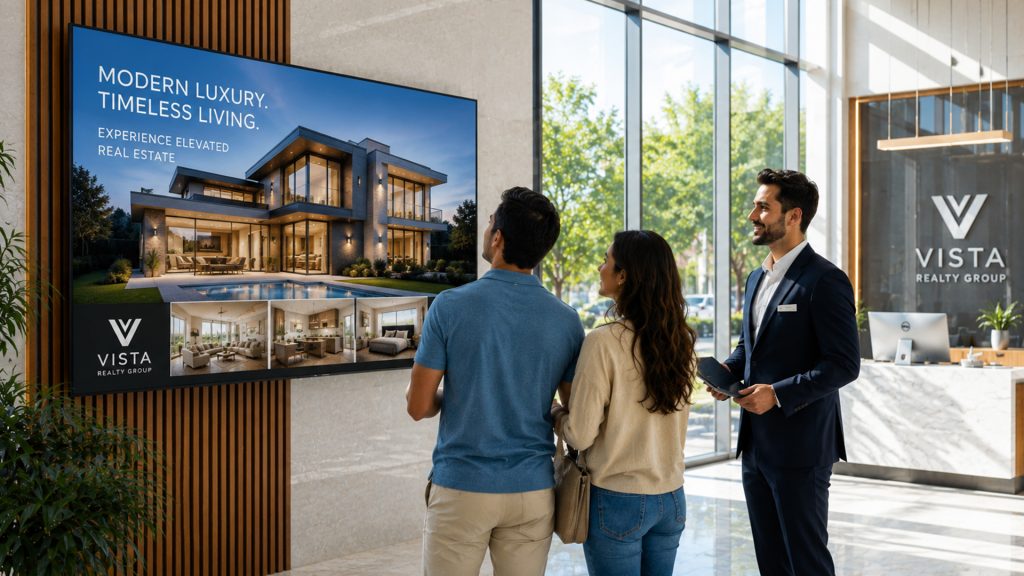
Here’s something that doesn’t get talked about enough: “Buyers make emotional decisions about properties before they make rational ones.”
Research from Zillow and various consumer psychology studies consistently shows that high-quality visuals, especially video and dynamic imagery, create emotional engagement that static photos simply can’t match. The brain processes visual information 60,000 times faster than text. Movement catches the eye. Good photography creates aspiration.
When a buyer sees a home on a beautiful, well-lit display screen, walking through rooms, seeing the light change, understanding the layout, they start imagining themselves in it. That emotional connection is what drives urgency. It’s what turns a browser into a buyer.
Real estate digital signage doesn’t just inform; it engages. It sells: quietly, consistently, and at scale.
The Business Case: What This Actually Costs vs. What It Returns
Let’s talk numbers, because ultimately every tool has to justify itself. The average brokerage spends thousands annually on printed marketing materials, flyers, brochures, window displays, and direct mail. Most of it is outdated within weeks and ends up in a recycling bin.
A digital signage system requires an upfront hardware investment (screens, media players) and a software subscription. Still, once it’s running, the content costs drop dramatically, no printing, no reprinting, no design-and-wait cycles. Updates happen in minutes, from anywhere.
Beyond cost savings, the return shows up in lead quality. Buyers who’ve engaged with your listing displays, who’ve read the specs, watched the walkthrough, and seen the price, arrive as warm leads. They’ve already done the emotional work. Your agents spend less time qualifying and more time closing.
A boutique luxury brokerage in Miami reported reducing its printed marketing budget by 60% in the year after deploying digital signage across two locations, while simultaneously increasing its walk-in consultation bookings by 24%. The screens paid for themselves in under eight months.
What to Look for in a Real Estate Digital Signage Solution
Not all platforms are built equal. If you’re evaluating options, here’s what actually matters for real estate specifically:
- MLS Integration: This is non-negotiable. If your displays can’t automatically pull live listing data, you’ll still have to do manual updates, which means someone will fall behind and your screens will eventually show outdated information.
- Ease of use: Your agents aren’t designers or developers. The platform should let anyone update content, swap a listing, change a price, and add a new agent bio in minutes, without a tutorial.
- Multi-location management. If you run more than one office, you need to manage all your screens from a single dashboard. Logging into five systems to make a single change isn’t sustainable.
- Scheduling and automation. The ability to schedule content, run weekday listings in the morning, lifestyle content in the evening, and open house reminders on weekends is what separates a smart system from a basic slideshow.
- Analytics. Which listings are getting the most screen time? Which content makes people stop and look? A good platform gives you data so you can make smarter decisions about what to display and when.
One More Thing: This Doesn’t Replace Your Agents. It Makes Them Better.
There’s always a worry with technology in real estate: “Is this replacing the human relationship?” It’s not. It never could.
What real estate digital signage does is handle the top of the funnel: awareness, first impressions, and early emotional engagement, so that by the time a buyer sits down with your agent, they’re already invested. They’ve seen the listing. They know the price. They’ve fallen a little bit in love with the kitchen.
Your agents get to skip the “let me tell you about this property” introduction and go straight to the real conversation: what does this buyer need, and how do we get them there? That’s a better use of your best people’s time. And it’s a better experience for your clients.
The Listings Are Waiting, So Are the Buyers
Every day your window shows a static printout, you’re leaving an opportunity on the sidewalk. Every evening, your lobby sits dark and silent, and a potential buyer drives past without stopping. Every open house that doesn’t happen is a showing that never takes place.
Real estate digital signage closes those gaps, quietly, reliably, and without asking anything of your team once it’s running.
The brokerages winning right now aren’t necessarily the ones with the most agents or the biggest advertising budgets. They’re the ones who figured out how to make their spaces work as hard as they do. Your listings deserve to be seen. Your buyers are already out there looking. The only question is whether your office is available to them at 9 am and at 9 pm.
Ready to see what this looks like for your brokerage? Try Disploy free for 14 days, no credit card, no commitment, no complicated setup. Just plug in, connect your listings, and watch your space start selling for you.