
Food truck owners know how quickly things can go wrong during the lunch rush. People line up, shout at you, and you don’t know what you’re serving. Before you realize it, you’ve served 12 people, and 30 minutes later, you’re running out of customers. A lot of cash lost, a lot of customers upset.
One of the easiest menu board upgrades available to address exactly these sorts of issues is a digital menu board for food trucks. Digital Menu Boards are always in full color, always up to date, and never washed out by bright sunlight; they actually draw customers into your truck.
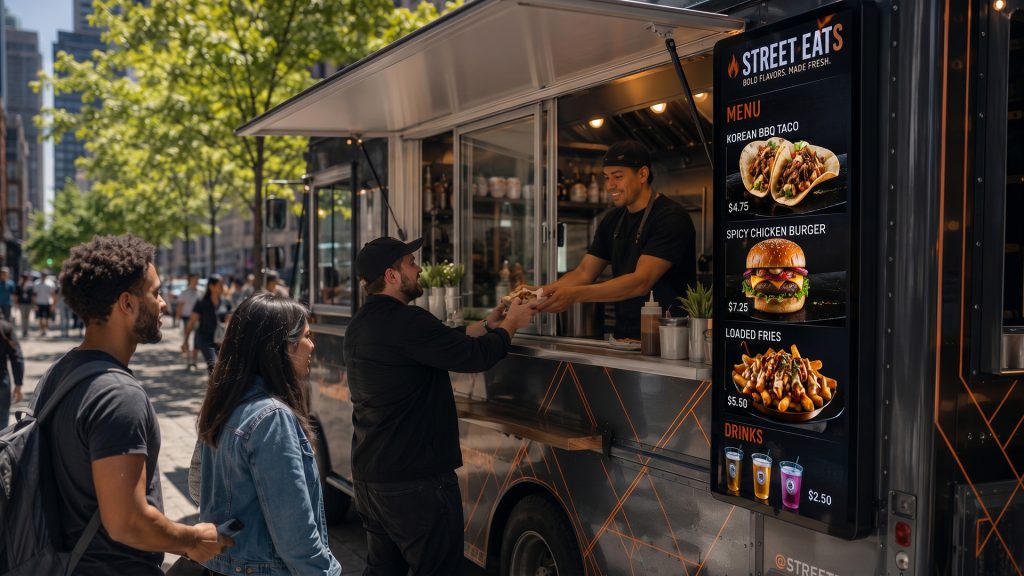
This blog post will take you through everything you need to know, how they work, the cost, software options, and, most importantly, how they help you serve more customers, sell more food, and run a smoother operation every single day on a food truck.
What Are Digital Menu Boards for Food Trucks?
A digital menu board for food trucks is a display screen, typically LCD or LED, that replaces a printed sign or chalkboard by displaying your menu. These are usually located either on the exterior of the food truck, visible to customers, or inside near the order window.
The difference between a regular TV screen and one of these is the software that is used. This software enables you to:
- Add your menu items, including pictures and prices
- Set prices in real time from your mobile or PC.
- Plan alternative meals for breakfast, lunch, and dinner
- Display promotional messages, countdowns, and social media handles
- Display sold-out items in a single tap
Food truck owners can get away with only one screen. Some opt for two or three screens to provide wider viewing angles and accommodate more people. It will depend on the truck’s size and the number of customers you generally serve at one time.
Why Traditional Printed Menus Are Holding Your Food Truck Back
It’s helpful to revisit the reasons behind the problems in the first place before jumping into the advantages of the new way.
Printed Menus and Chalkboards Have Real Limitations
- They cannot be updated quickly. If you run out of a dish, you either have to write it on a separate piece of paper or tell every single person who walks up. Both options slow everything down.
- They are hard to read from a distance. A chalkboard or a printed sheet works fine when someone is standing right in front of it. But the person at the back of a ten-person line cannot read it, so they are not deciding what to order yet.
- They look unprofessional over time. Printed menus fade, get grease stains, and look worn after just a few weeks.
- They do not show what the food actually looks like. A simple text description of your “Spicy Korean BBQ Burger” does not tell the same story as a high-quality photo.
- They make seasonal changes a headache. Updating a printed menu means going back to the printer, paying for new materials, and waiting for them to arrive.
All of these combine to take away your customers and money week by week.
How Digital Menu Boards Boost Sales
Eye-Catching Visuals Drive Impulse Purchases
Fast-food companies invest heavily in food photography for a reason! When you see a close-up photo of a perfectly made burger or a new bowl of loaded fries, you feel hungry. People who were just looking at your website are much more likely to order your signature dish if they see a nice picture of it with a glowing screen, even if they weren’t considering ordering it.
Research on restaurant digital signage has shown that menus featuring food photography can boost sales of individual dishes by 30% or more. How many times has QSR Magazine reported on how visual merchandising in and around food service locations can impact how much customers spend at that establishment?
This is even more important if you are running a food truck, since you only have about 15-30 seconds to capture a passerby’s interest before they walk by. There’s a more effective way to do that, though: a bright, clear digital screen that rotates food images.
Easy Upselling and Cross-Selling
Digital menu boards let you create promotions without having to talk about them. For example:
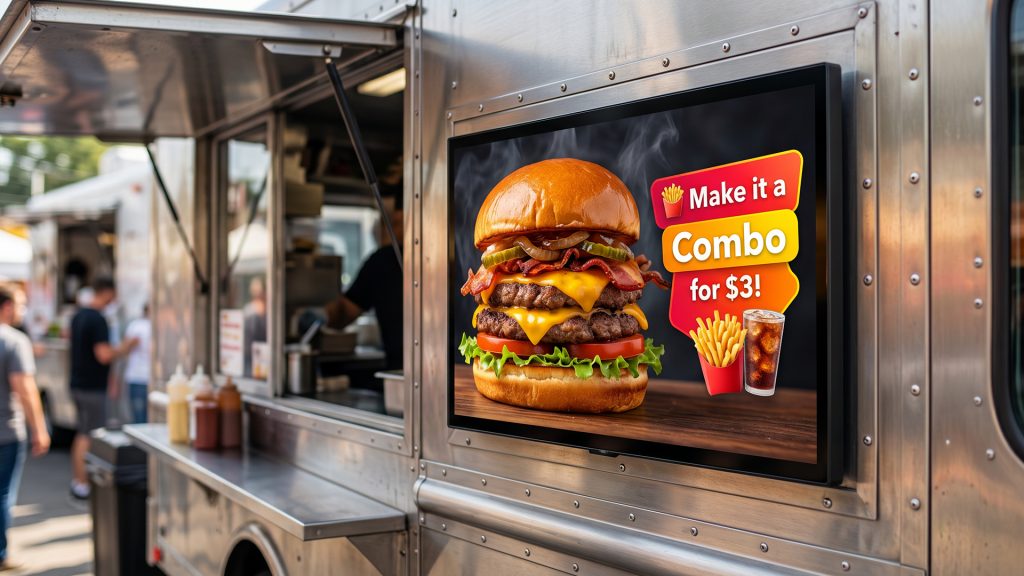
- Next to your burger, you’ll see “Add a drink and fries for $3 more” – these are suggested bundles.
- Combo offers: A graphic of three items offered at a discount
- Make it a double patty for $2,” displayed as an animated badge on the burger image.
These types of cues are effective. Cornell University’s Center for Hospitality Research found that visual cues and the placement of high-margin items actually increase the likelihood that a customer will spend more per transaction. There’s no salesperson to speak with. The screen will do the job for you.
Highlighting Specials and Limited-Time Offers
One of the greatest benefits of digital menu boards for a food truck is the ability to run time-sensitive promotions with no extra work. A “Happy Hour” menu can be programmed to automatically display between 2 PM and 4 PM, with special pricing. The screen automatically returns to your normal menu at 4 PM.
Another way to make an urgent statement is to use phrases such as:
- Today Only: Mango Habanero Wings
- Last 10 Portions of the Day: Truffle Mac and Cheese
- Weekend Special: Buy 2 Get 1 Free Tacos Saturday Only
Those types of messages will encourage customers to order without thinking twice, and at a food truck, you can’t afford to let anybody second-guess their order while they’re on lunch break.
Seasonal Menu Flexibility
Whether you have a food truck that operates seasonally or year-round, there’s bound to be some seasonal variation in your menu. During the summer, you can try pushing cold drinks, fresh salads, and lighter wraps. During the winter months, you’re in the mood for hot soups, hot sandwiches, and comfort foods. A digital menu board allows you to change menu displays from season to season in just a few minutes, rather than sending them to the print shop. You can even save both menu plans in your software, have them ready to go, and switch between them as opportunities arise.
How Digital Menu Boards Cut Wait Times
Customers Decide Faster
This is likely one of the most straightforward methods. Digital menu boards are time savers. If they can see your menu easily from the back of the line, before they come to the window, they already know what they want to order.
Consider how it would feel if someone approached your window and didn’t know what they wanted. They ponder the menu, ask questions, and change their thoughts. This one unsure customer will slow you down by 2-3 minutes. If it’s 10 to 15 minutes of lost serving time multiplied by even five, you’re losing 5 hours of service time per hour.
This is a great advantage because people are reading, deciding, and in some cases, engaging in a conversation about what they are ordering, with the person they are with, who is standing in line with them, while they are still in the waiting line, which can be as long as 20 to 30 feet. They’re ready by the window. This change alone can save between 30 and 90 seconds per transaction, on average.
Fewer Order Mistakes
It’s hard to imagine how many times people have been surprised to receive something they weren’t expecting when ordering, and the fewer times that happens, the better. It is difficult to imagine how many times customers have received items that they were not expecting, such as pictures, descriptions, and allergy information (if provided), other than what they had ordered. This cuts down on a person saying, “Wait, I thought it included fries,” or “I didn’t know it contained onions.
One of the most time-consuming tasks in a food truck business is ordering corrections. Each time you need to reorder and refund an order, you’re losing time, food money, and the trust of the person behind the customer.
Real-Time Menu Updates Prevent Confusion
If you have it sold out, you can tick it off on your electronic board as soon as you run out. This means:
- Customers do not walk up and order something you cannot make
- You don’t have to tell everyone about the situation.
- There is no stopping the line from continuing without breaks.
This is particularly useful when you’re very busy and can’t get to talking about what you have and what you don’t.
Key Features to Look for in a Food Truck Digital Menu Board
Not every digital menu board system is the same. As you’re looking around, consider these features critical for a food truck:
- Outdoor Visibility
If the screen will be viewed in strong sunlight outdoors, get one that is 2500 nits or higher. It will be nearly impossible to read on a normal TV in bright sunlight.
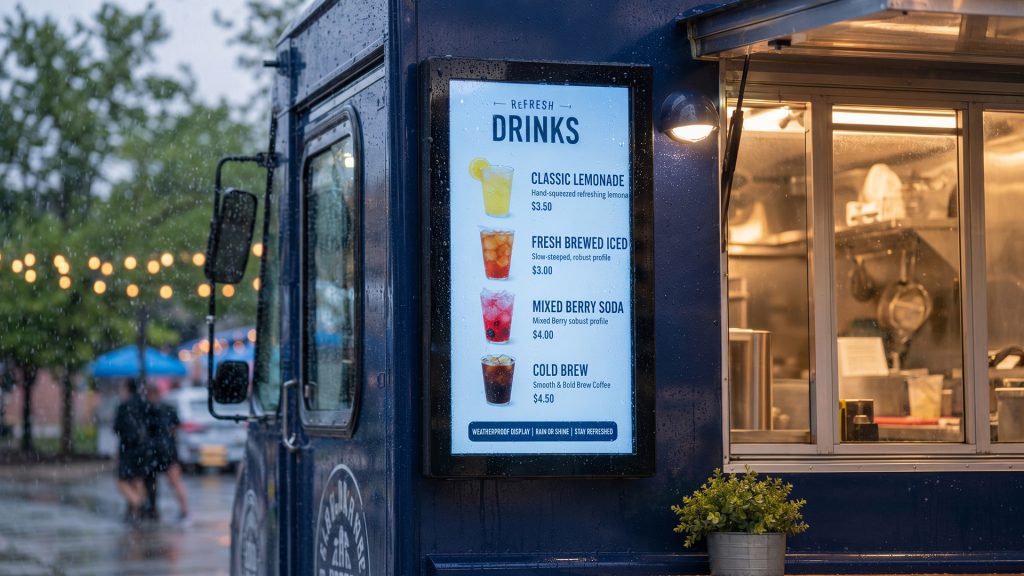
- Weather Resistance
Your screen should be able to withstand heat, humidity, dust, and even splashes of water. For outdoor use, look for displays that have an IP54 rating or higher.
- Easy Content Management
You need to be able to update your menu from your mobile device in under a minute; this is why the menu should be available in the software. The last thing you want to do is navigate a complex interface when you’re hungry.
- Scheduling Features
A great operational benefit is the ability to offer different menus for different times of day or days of the week.
- Media Support
It should not only be able to process text but also handle high-resolution graphics, short video clips, and animated graphics.
- Offline Functionality
As your internet connection drops (and it will drop, at some point), your menu should still display. Seek storage systems that have local storage capabilities.
- Remote Management
Running several food trucks will appreciate having all menus in one place.
How to Set Up Digital Menu Boards on Your Food Truck
Setting up a digital menu board on your food truck does not require technical expertise. Here is a simple step-by-step overview:
Step 1: Choose your screen
Step 2: Choose your software
Step 3: Mount the screen
Step 4: Connect to power
Step 5: Design your menu
Step 6: Test it in different lighting conditions
Step 7: Set up your schedule
Real-World Results: Food Trucks That Made the Switch
Businesses across the country have seen measurable improvements since converting to digital menu boards for their food trucks. A few of the types of results that are shared, either in food truck communities or in industry publications, are:
- Average order value rises by 10-25%: Many operators report a 10-25% increase in average ticket value after introducing food photography and combo suggestions to their digital boards.
- Improved service: The average service time reductions reported range from 20 seconds to more than 1 minute per customer, which, at a busy location, translates to serving 10-20 more customers per day.
- Less frustration over sold-out products: Real-time info eliminates the aggravation clients experience when requesting an out-of-stock product.
- An easy way to get more followers on your social media: Put your Instagram ID or QR code on your digital sign so that there’s a reason for people to look at the screen.
Common Concerns About Digital Menu Boards
“What if the screen breaks or gets damaged?”
Commercial-grade displays are weather-resistant. The majority have warranties. Also, remember that the cost of a broken screen is a one-time cost, but the cost of a menu that is not obvious or intuitive is a continuing loss of revenue.
“What if I lose internet connection?”
The best digital signage software will keep your content on a local device. Even if you don’t have internet or mobile data, your menu will still be visible.
“Is it too expensive for a small food truck?”
Basic configurations are as low as $300-$500, with a high-cost subscription to the software, though the software is free or low-cost. Most food truck owners recoup their costs in the first few months, when you factor in the average rise in sales.
“I’m not tech-savvy. Will I be able to manage it?”
Today’s digital menu board systems are made to be user-friendly. A digital menu board system can be used as long as the user can drag and drop files onto a computer and use a smartphone.
“What about sunlight washing out the screen?”
This is a legitimate issue with consumer TVs, but commercial outdoor TVs are engineered to be readable in bright sunlight. Seek screens that have 2,500 or more nits of brightness.
Cost Breakdown: What to Expect When You Invest
Here is a realistic look at what you might spend on a digital menu boards setup for your food truck:
| Item | Low-End Estimate | Mid-Range Estimate | High-End Estimate |
| Commercial outdoor display (32″–55″) | $350 | $700 | $1,500+ |
| Digital signage software (annual) | Free-$120 | $120-$300 | $300-$600 |
| Mounting and installation | $100 | $200 | $400 |
| Content design (one-time) | $0 (DIY) | $150 | $500 |
| Total First-Year Cost | ~$450 | ~$1,350 | ~$3,000 |
For most food truck operators, a mid-range setup in the $800-$1,500 range gives a great balance of quality, reliability, and features. If you serve an average of 80 customers per day and each customer spends just $1 more due to better visual merchandising, that is an extra $80 per day, meaning your investment can pay for itself in as little as two to three weeks.
Tips to Get the Most Out of Your Digital Menu Boards
With your digital menu boards in place, here are some useful tips to help them work even harder for you:
Keep Your Menu Clean and Simple
Avoid showing off all your offers at once. The right kind of menu is more effective than a wall of text and photos: it’s clear and concise, with a limited, rotating selection of what you know will be popular and profitable.
Use Real Photos of Your Food
Most smartphones today can produce fantastic food photographs. Natural light is best. Use real photos of your real meals, not stock photos, for this builds trust and authenticity.
Rotate Content Regularly
Rotate slides every couple of weeks to keep regular customers from getting bored. Even an occasional change in offerings, such as a new combination or a new dish, makes the display new and exciting.
Add a Call to Action
Provide people with activities other than ordering. Share your Instagram account, a QR code to your website or loyalty program, or a simple hashtag, such as “Tag us in your food photo for 10% off next time”.
Match Your Branding
The digital menu boards should be more closely aligned with your brand than any other menu board. Be consistent with your use of colors, fonts, and logo. Good branding on the display can create a more memorable and professional look for your food truck.
Monitor What Is Working
When you sell more of a specific product, monitor your digital signage software to ensure it is tracking customer interactions. If you have a POS system, you’ll know which products are selling more after being prominently displayed. Use that information to make better-informed decisions about what to promote.
Plan Ahead for Events and Catering
If you book event gigs or catering jobs, you can pre-load a custom menu just for that event and switch to it with a single tap. This will help you appear poised and professional in front of crowds.
Conclusion
Digital menu boards for food trucks are not a luxury; they’re a solution to real problems they face daily. It’s faster to convert customers, reduce order errors, promote higher-value combos, and execute time-sensitive promotions with no effort; it’s easy to see and easy to quantify.
The technology is easier to use than ever before. You don’t need a large budget or technical knowledge to get started. Just a little investment in a comprehensive sign or a straightforward subscription to sign software can significantly affect the number of customers your business serves, the amount they spend with you, and the efficiency of your overall operations.
If you’re still using a chalkboard or a printed laminate sheet, you are missing out on money and customers. The food trucks that are emerging are the ones with the most intelligent, small fixes that make a difference in the long run, and updating to a digital menu board is one of them. Looking to advance your career? Begin with a free trial of Disploy to experience first-hand how simple it can be to run your menu digitally.