Walk into any bank branch today, and you'll notice something odd: most of them still look like they did fifteen years ago. Laminated posters taped to the glass. A whiteboard with today's interest rates written in marker that's starting to fade. A queue token system that beeps but tells you nothing else. Meanwhile, the bank's own app has a slick interface, real-time updates, and built-in personalization. The branch, for all its importance, hasn't caught up.
This mismatch matters more than banks think. Customers who still walk into a branch are usually there for something that requires a human: a loan conversation, a dispute, opening a new account, or simply because they trust face-to-face more than an app for anything involving their money. That means the branch experience is doing a lot of emotional heavy lifting. And right now, in most banks, it's underperforming.
Bank digital signage isn't about looking flashy. It's about closing this gap between how modern a bank claims to be and how modern its physical spaces actually feel.
The real cost problem nobody talks about

Every bank branch runs on print. New interest rate sheets, updated compliance notices, seasonal loan offers, holiday hour changes, all of it printed, laminated, and physically swapped out by branch staff. Add up the design time, the printing costs, the courier or delivery costs to hundreds of branches, and the labor cost of a branch employee removing yesterday's poster and taping up today's; it's not a small number. And it's not a one-time cost. It repeats every time something changes, which happens often in banking.
Then there's the version control problem. A national bank with 300 branches trying to update a promotional offer across all locations on the same day using printed materials is almost guaranteed to have inconsistencies. Some branches update on time. Some run the old poster for another week because the new one hasn't arrived yet. Some put it up crooked, half-hidden behind a plant. None of this is anyone's fault exactly; it's just what happens when your communication system depends on physical objects moving through a logistics chain.
Digital signage collapses that entire chain into one action: update the content once, centrally, and it appears everywhere at the same time. A compliance change that needs to go live at 9 AM sharp across every branch can actually go live at 9 AM sharp across every branch. That's not a minor convenience; for regulated industries like banking, timing and consistency of disclosures actually matter.
Trust is built in small, boring moments
Here's something people underestimate about banking specifically: customers don't trust banks because of grand gestures. They trust banks because of a hundred small, boring, consistent moments: the teller who remembers their name, the wait time that's roughly what they were told it would be, the sense that this institution is organized and on top of things.
A branch that looks cluttered, has outdated signage, or displays a rate that doesn't match what the loan officer just quoted you creates tiny cracks in that trust. It's subconscious, but it's real. A customer standing in line looking at a five-month-old poster for an expired promotion isn't thinking "that's odd"; they're thinking, on some low level, "does this place have its act together?"
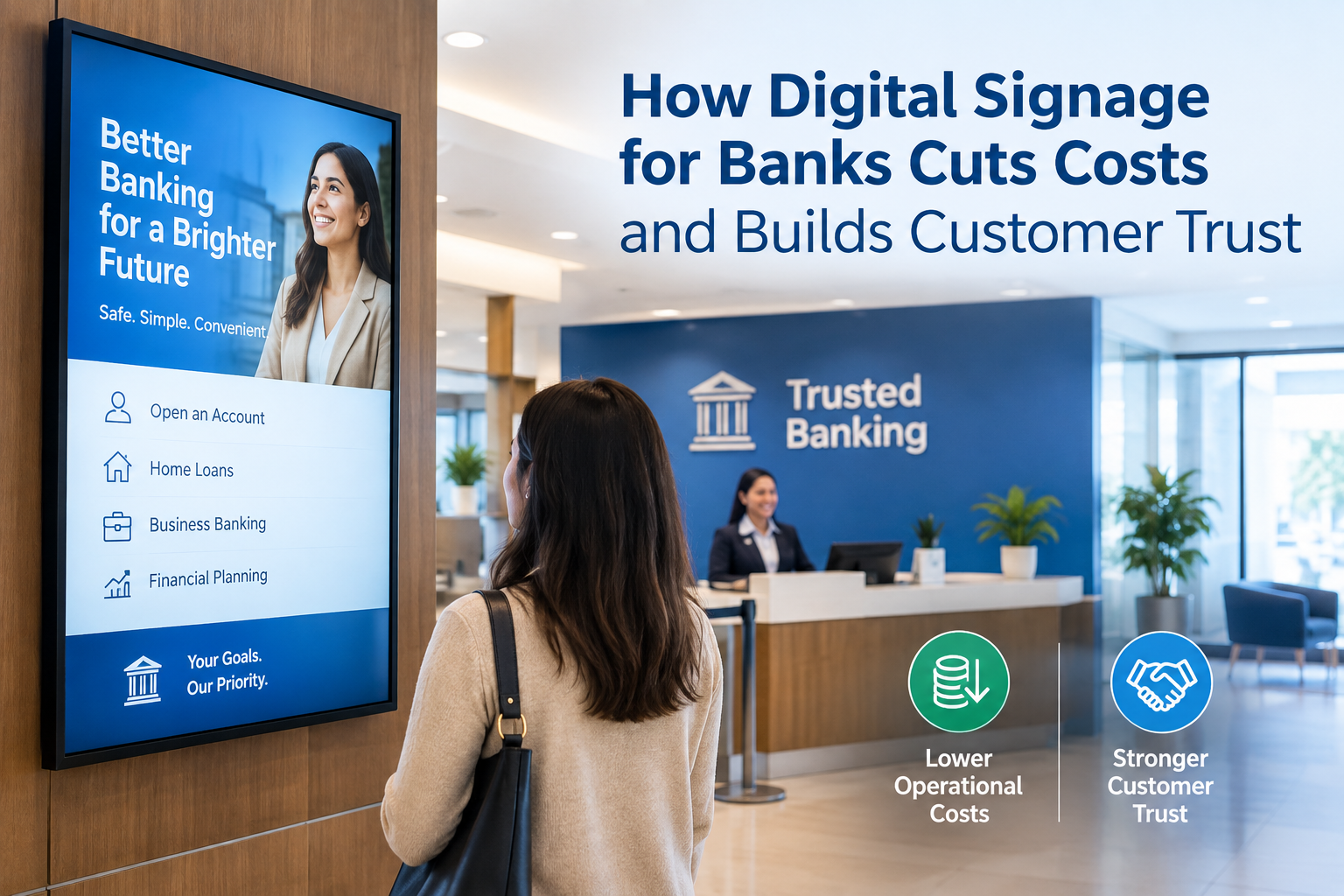
Digital signage flips this. A screen displaying today's date, live queue numbers, current forex rates, or a personalized welcome message signals to the customer, without saying it outright, that this branch is up to date, attentive, and running smoothly. It's a small signal, but trust is built out of small signals stacked on top of each other.
Where digital signage actually earns its keep in a branch
It's worth being specific here, because "put up some screens" isn't a strategy on its own.
-
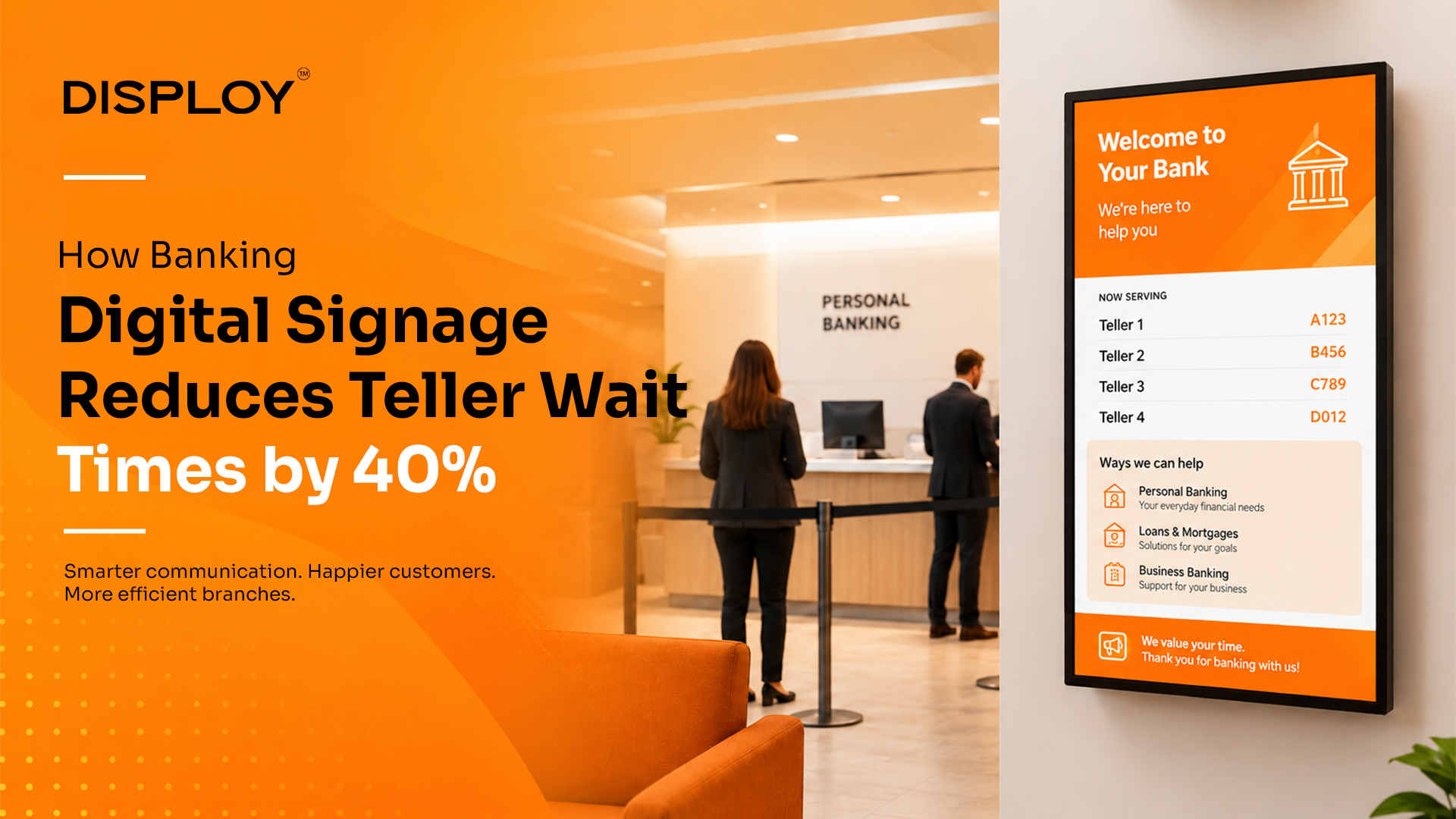
Queue and wait-time management. Instead of a static token number with no context, a screen can show which counter is next, roughly how long the wait will be, and gently direct customers' attention elsewhere while they wait, which brings us to the next point.
-
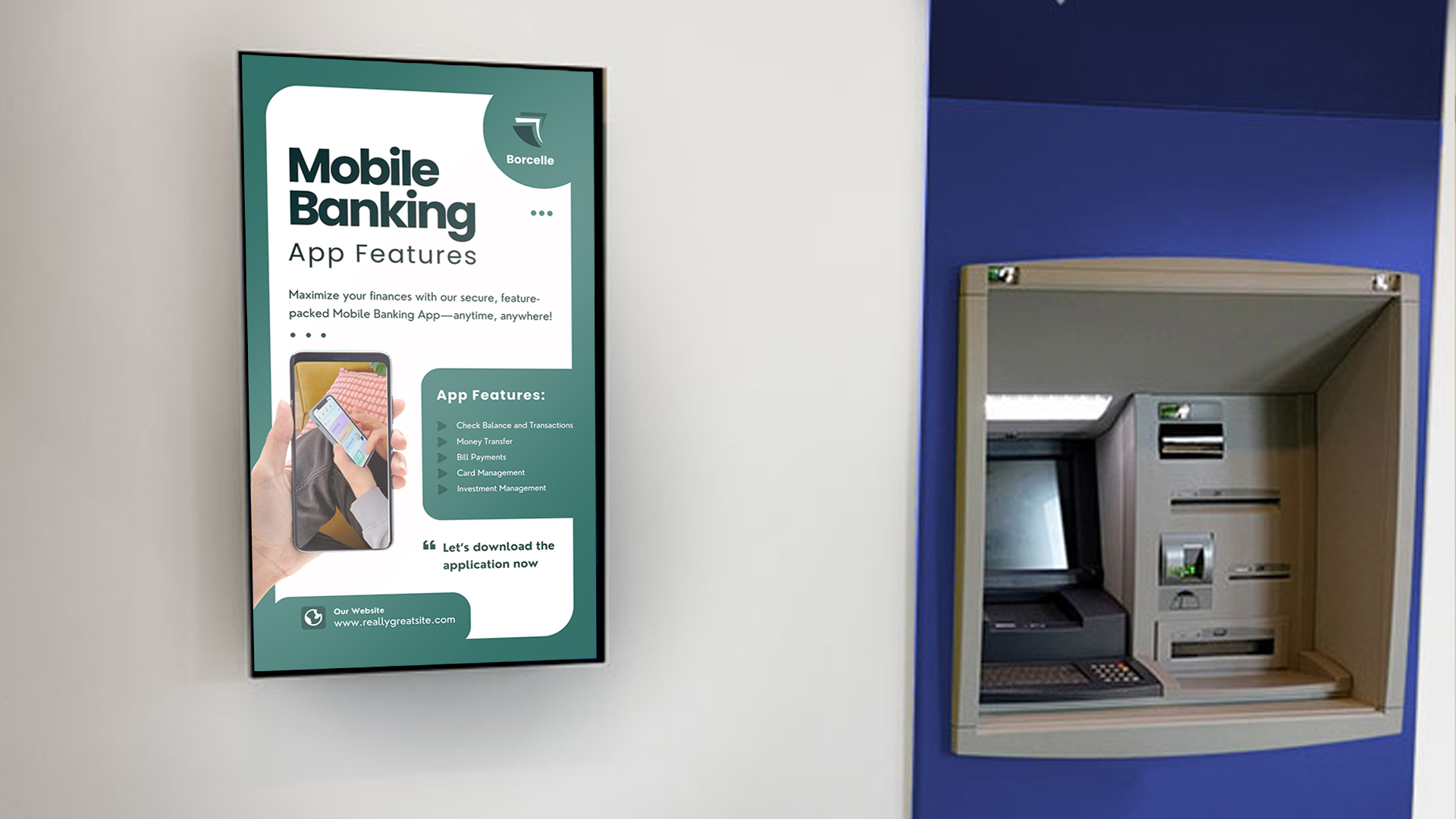
Cross-selling without a hard sell. A customer waiting for locker access might see a screen showing a fixed deposit rate they weren't aware of. This isn't a pushy sales pitch; it's information delivered at a moment when the person has nothing else to do but glance around. Banks that use this well see it as a quiet, low-pressure way to make customers aware of products they'd never proactively ask about.
-
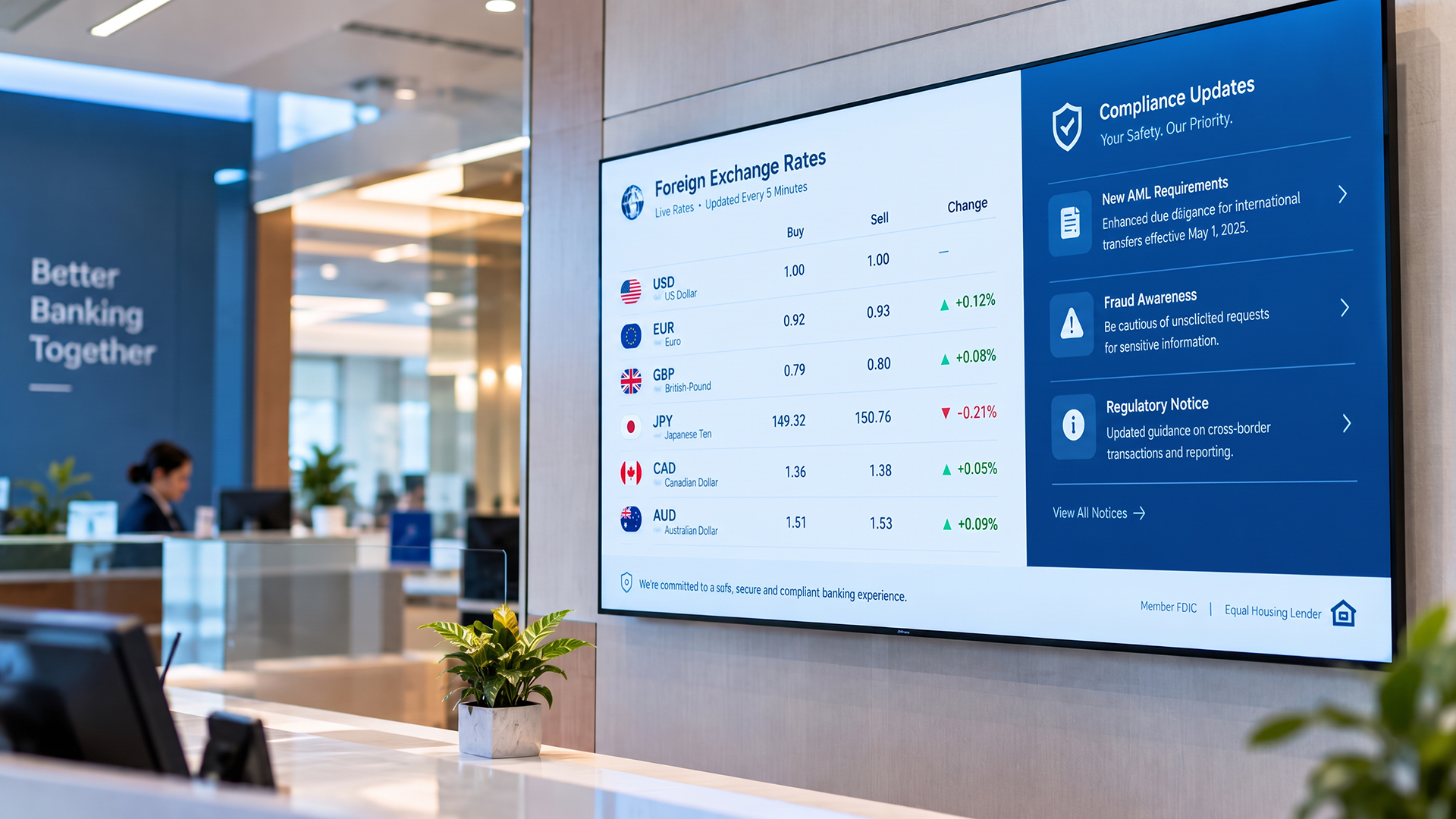
Compliance and regulatory notices. Interest rate disclosures, updated KYC requirements, and fraud alerts need to be visible, up to date, and legible. A digital screen guarantees the latest version is always displayed, with no chance of an outdated print notice lingering by accident.
-
Emergency and security communication. In the rare event of a system outage, a security concern, or a schedule change, a message can go out to every branch screen within minutes. Try doing that with paper.
-
Localized offers. A branch in a college town can show student loan offers. A branch near a business district can show SME banking products. Centralized software with localized scheduling means a single system can serve very different customer bases appropriately, without anyone having to manually customize each branch's materials.
The upgrade doesn't need to be dramatic
One thing that holds banks back is imagining this as an enormous IT overhaul, new hardware everywhere, a huge redesign, months of implementation. It doesn't have to be that. A cloud-based digital signage platform can run on relatively simple displays, be managed from one dashboard, and be rolled out branch by branch rather than all at once. Content can be scheduled in advance, updated remotely, and tailored by branch, region, or even time of day, all without anyone needing to physically visit a location in person.
This is really the core shift: signage stops being a physical object someone has to manage by hand, and becomes a piece of software that runs itself once it's set up properly.

Conclusion
Fewer printing costs. Faster, more consistent rollout of updates and compliance notices. A branch environment that visually matches the modern, digital-first image the bank projects everywhere else: its app, its website, its ads. And a customer experience that feels a little more attentive, a little more current, and a little more trustworthy, one small screen at a time.
Banking is a trust business before it's anything else. The physical branch is one of the few places left where that trust gets built face-to-face. It's worth making sure the walls in that branch say the same thing as the bank's marketing team does.
Ready to modernize your branch experience without the operational headache? Disploy's cloud-based digital signage platform lets banks manage content across every branch from a single dashboard, schedule compliance updates, promotional offers, and queue information centrally, and push them live instantly, everywhere. If you're ready to see what a smarter branch could look like, get in touch with Disploy for a walkthrough tailored to your branch network.