Imagine that you're rushing through a busy airport, carrying heavy bags, your coffee growing colder, with no idea where Gate 47 is. You look for a sign, but the only thing you come across is an old, faded notice with very small letters that are almost impossible to read. Does this scenario sound familiar? It is one of the most stressful things a traveler can experience: missing a flight, train, or bus because of confusing or outdated information. In such a case, time is wasted, costs are incurred, and the day can be completely ruined or even the entire trip spoiled.
That is exactly the reason why digital signage has become so important in transportation hubs all over the world. Today, airports, rail stations, bus terminals, and ferry ports are employing smart digital screens to make sure that passengers get the right information at the right time. In this article we will look at how digital signage functions, why it is much better than traditional printed signs, and most importantly how it helps to reduce missed connections. By the end of the article you will see that these bright screens are not just pleasant to look at; they actually help to prevent people from missing their journeys every day.
What counts as digital signage and why is it significant for the transportation sector?
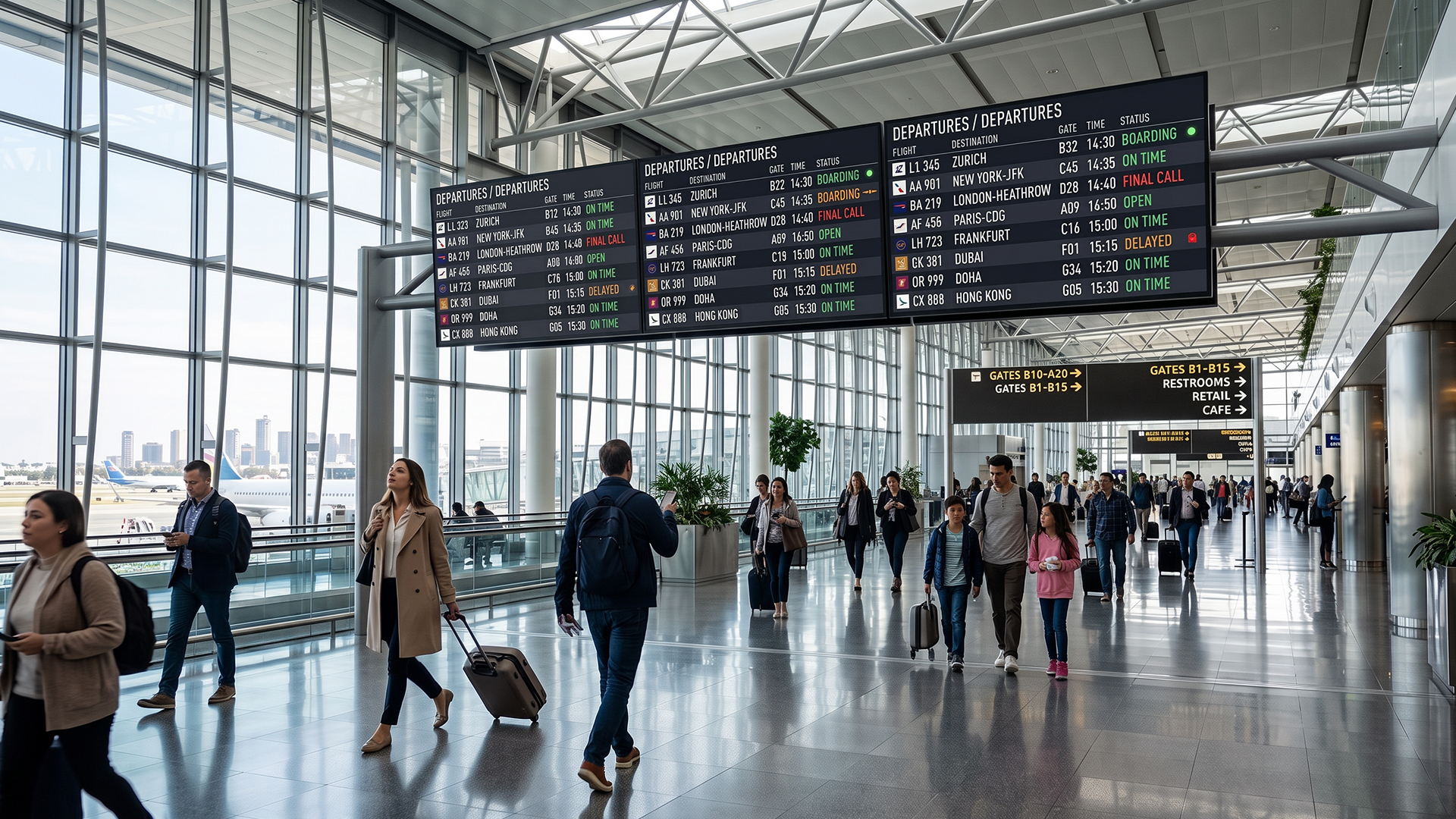
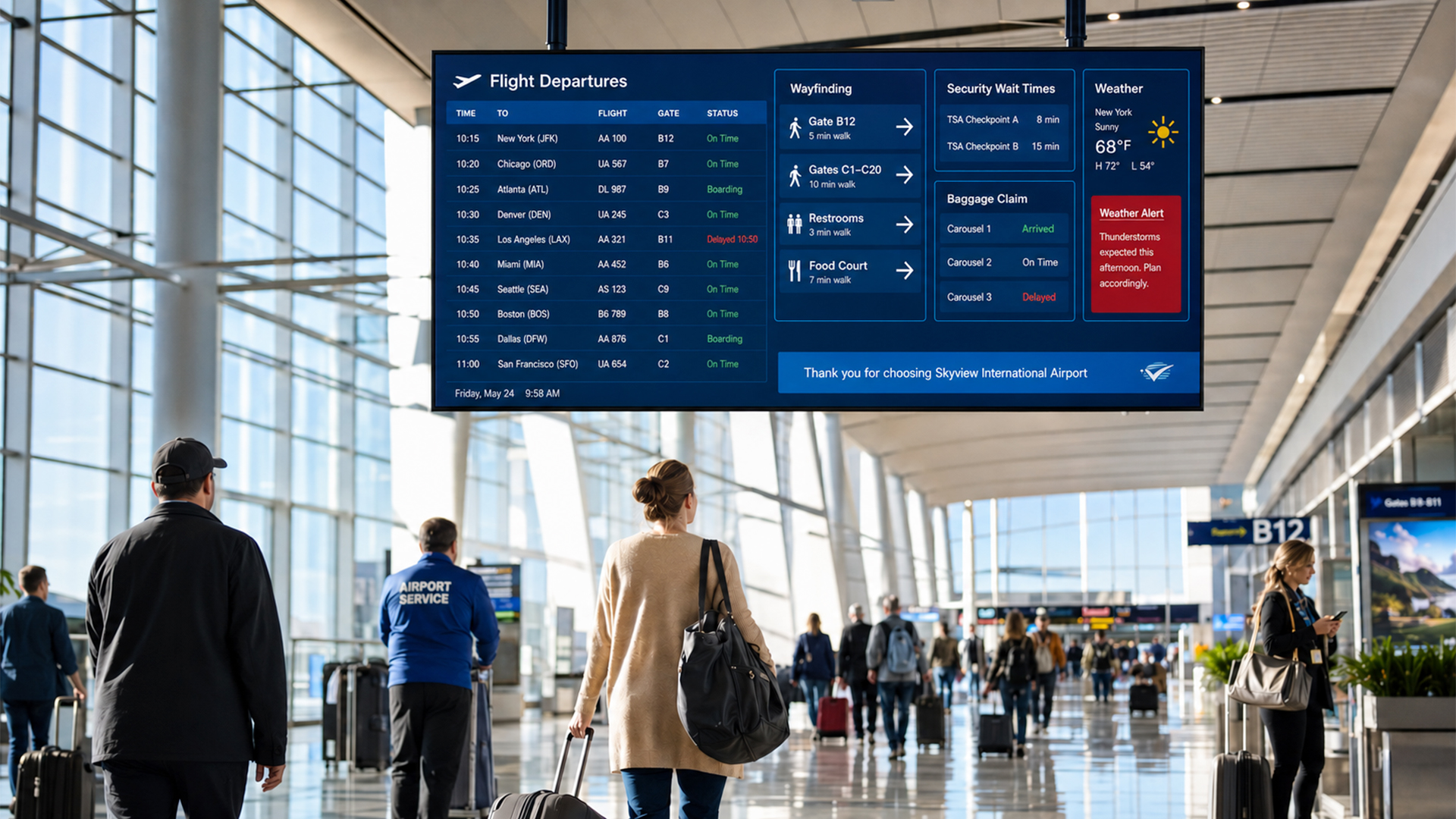
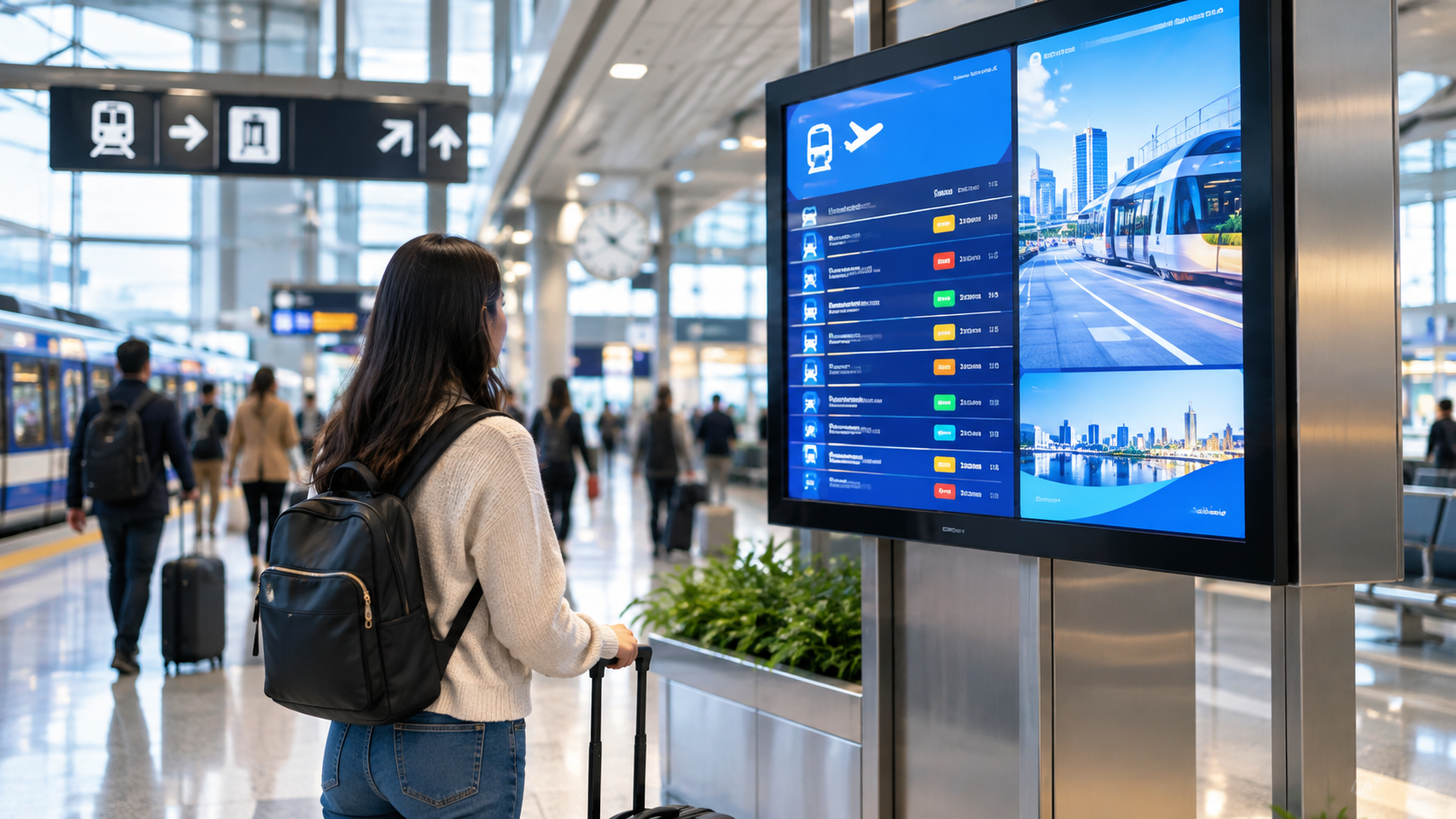
Digital signage is a system of electronic screens that display information, images, videos, and messages and can be updated in real time. It's like a highly intelligent TV that knows exactly what information you need and displays it at the moment you need it. In locations where people travel, such as airports and railway stations, the screens are placed in high-traffic areas, for instance, at entrances, along corridors, in waiting areas, and near gates or platforms.
So why is this so important? Because transportation hubs deal with hundreds or even thousands of people every day; it is necessary that all concerned people are quickly informed if a flight is delayed, a platform is changed, or the bus timetable is altered. Printed signs or fixed displays are clearly unable to keep up with the speed at which arrangements change. For instance, a printed notice stating 'Gate 12' becomes completely useless if the gate has just been moved to 'Gate 34' five minutes before boarding.
Digital displays deal with this issue by automatically and very quickly updating information. When an airline or a train company makes a change, the update can appear on all the screens in the building at the same time. There is no room for confusion, there is no need to go to a customer service desk, and there is no need to stand there squinting at an old board in an attempt to figure out what it says. The screens are large, bright, and easy to read even from a distance, something which makes a big difference to travelers who are already under stress and in a hurry.
Heathrow Airport in London is an example of this. The airport has made heavy investments in digital signage systems that display flight information in real time on hundreds of screens. Passengers can then quickly check the screen next to them and immediately see whether their flight is on time, delayed, or has been moved to a different gate. The ability to communicate in this way prevents thousands of people from missing their connections each year.
How Real-Time Updates Stop the Chaos of Missed Connections
One of the main reasons why people miss their connections is that they do not get the information they need in time. For example, an announcement about a gate change might have been made over the public address system, but the noise in the terminal was too great for it to be heard clearly. It is also possible that someone was in the toilet when the announcement was made. Or maybe they just relied on the old sign and went to the wrong place. All of these situations are very common and happen every day in busy transportation centers.
Digital signage solves this problem by ensuring that information is visible at all times and throughout the space. Instead of relying solely on announcements, which people may miss, the digital screens broadcast the message throughout the building. So, whether someone is sitting in a coffee shop, walking down a corridor, or waiting at the security office, they can see the latest updates on the nearest screen. Consequently, fewer people are left out of the loop when it comes to important changes.
A further interesting point is that contemporary digital signage systems can be connected to the transport hub's main data system. For example, when a train is delayed by 15 minutes, the information is automatically transmitted to all relevant screens rather than being entered manually. This type of intelligent automation means that the updates occur in seconds rather than minutes. For someone with only a short time to catch their connection, those seconds can be the difference between arriving on time and not.
Suppose you are at a busy train station in Chicago and your connecting train has just been moved to a different platform. If there is no digital signage, you won't find out until you've already got onto the wrong platform and are watching your train pull away. However, with a properly situated digital screen, you would have seen the change two minutes earlier and could then calmly go to the right platform. It's not merely convenient to have this sort of information; it's surprisingly easy to get lost in a large transportation center. In some airports, the buildings are so big that they have had to introduce tram systems just to get people between terminals. Train stations can have dozens of platforms and several floors. Even experienced travelers can end up entirely disoriented and confused without good guidance.
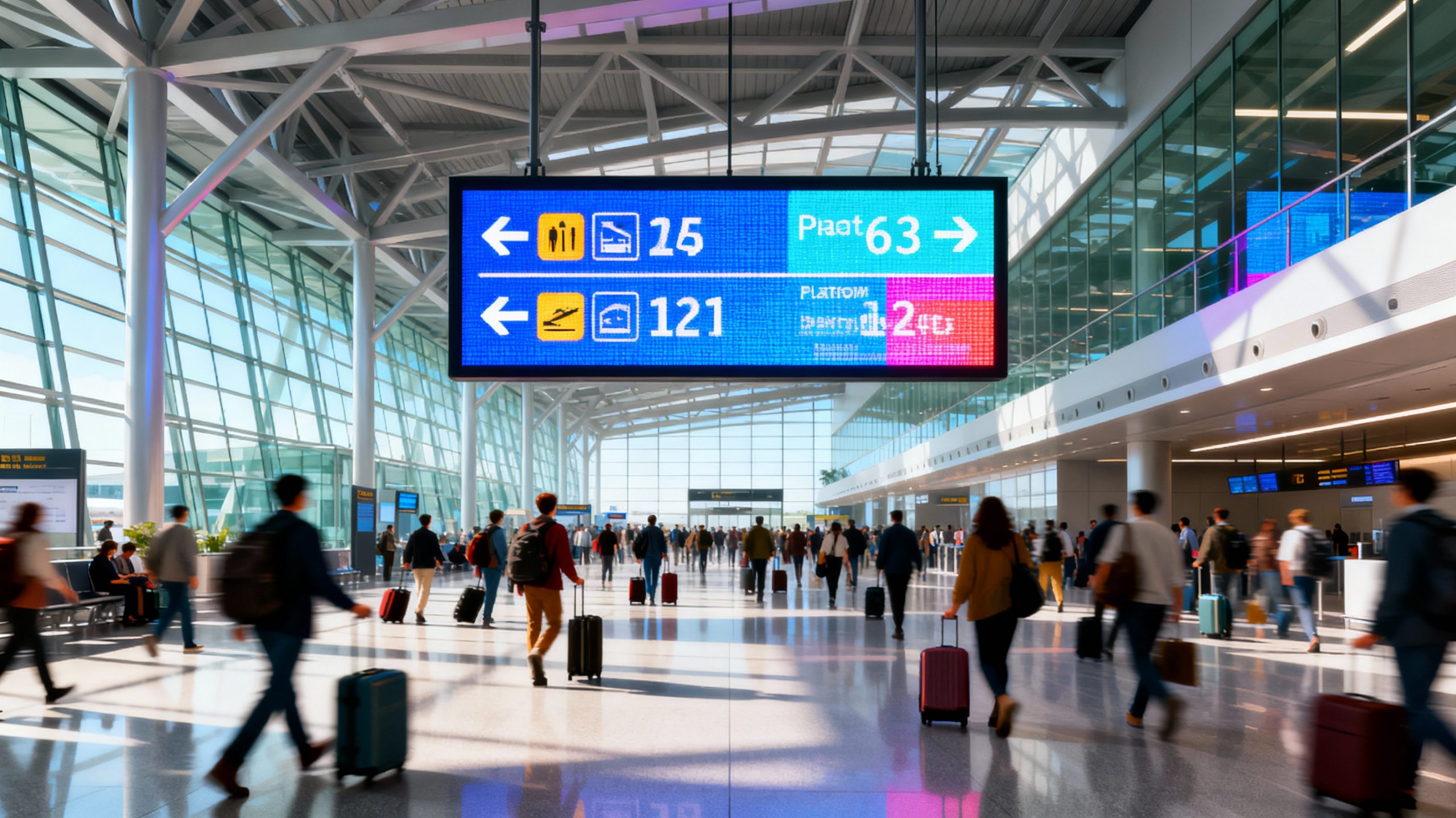
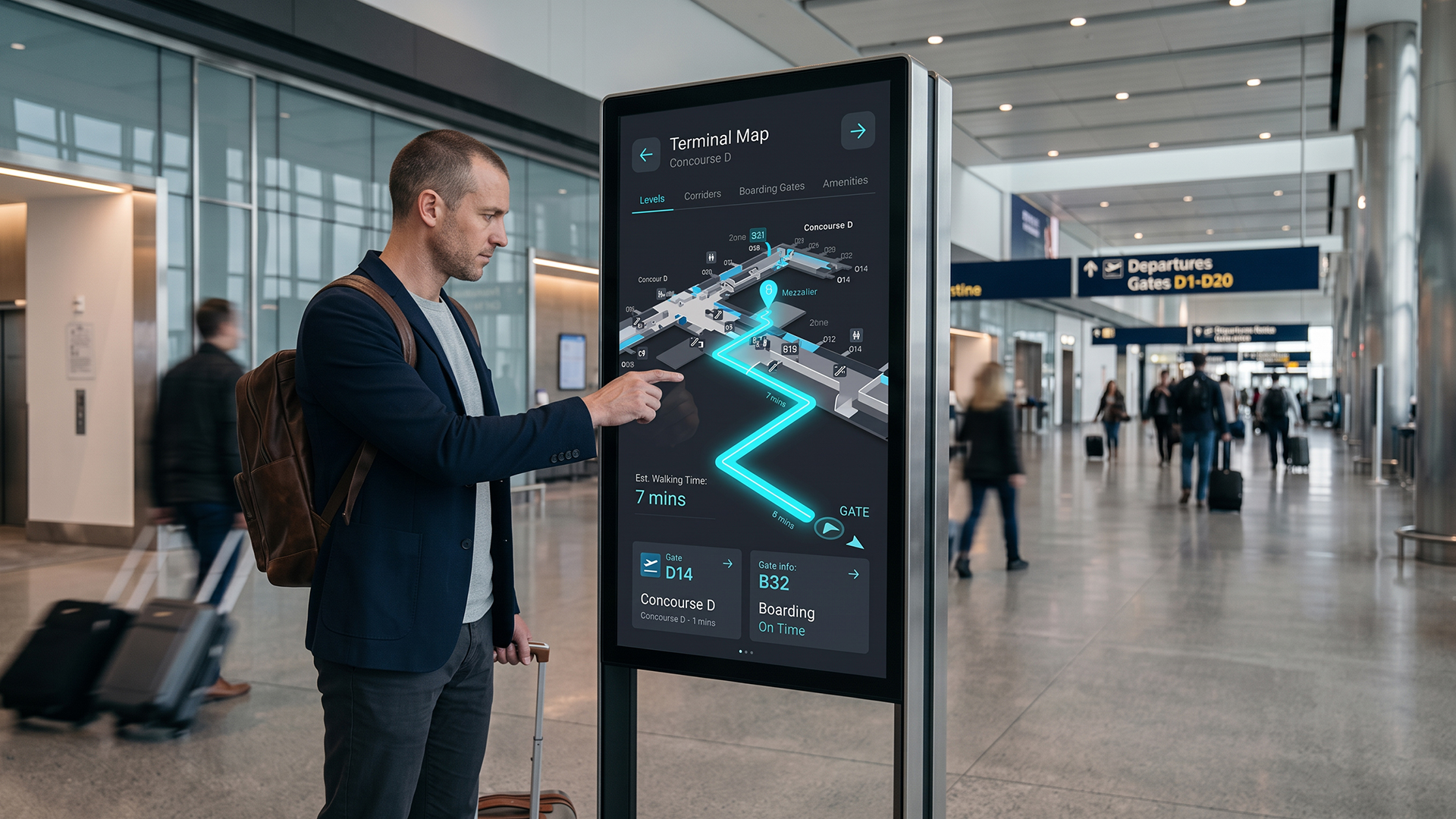
It is precisely in this situation that Wayfinding digital signage proves its value. Wayfinding screens are a type of digital display that help people determine their current location and find how to get to the places they wish to visit. You can think of them as a GPS system inside a building; the screens show maps, directions, walking times, and, in some cases, even step-by-step instructions to help travelers navigate the area.
What is special about these screens is that they can display personal information. In more advanced systems, travelers can enter their flight number or destination, after which the screen tells them exactly which direction to go and how long it will take to get there. This is particularly useful for first-time visitors or elderly passengers who might have difficulty navigating the complex layout on their own.
For example, at Amsterdam's Schiphol Airport, there are wayfinding screens and interactive kiosks that help passengers navigate the terminal. The screens display clear arrows, walking distances, and details about possible delays along their route. It has been found that airports with efficient wayfinding systems see a significant decrease in missed connections because people no longer get lost. This serves as an example of the power of smart digital signage in action.
Multilingual Displays: Helping Every Traveler, Not Just Some
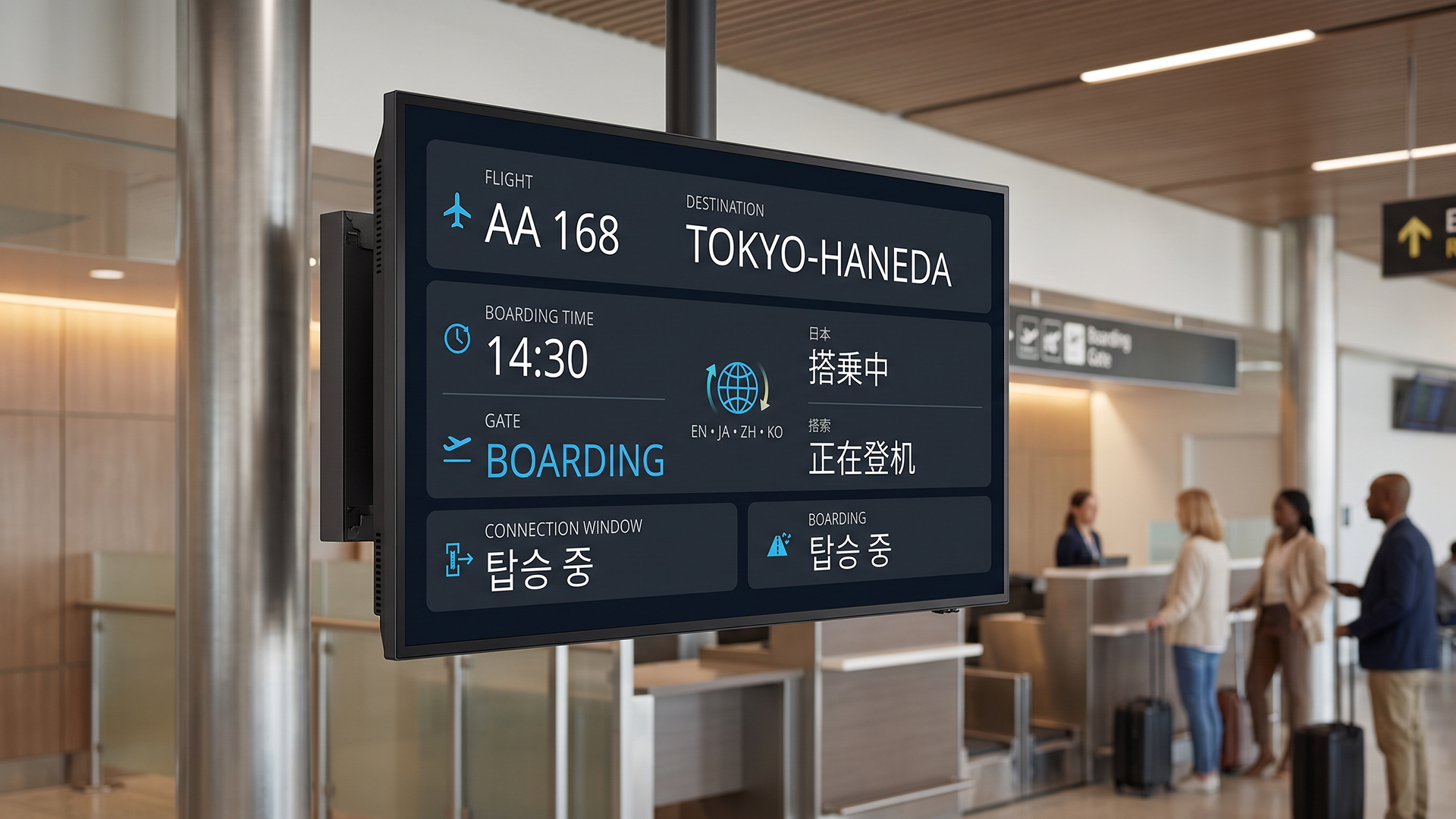
Transportation centers are international in character. Each day a large number of passengers from various countries go through the same airport or rail station. Not all of them speak the local language, and this language barrier can therefore be a serious problem when someone is trying to work things out. A clever solution has been developed to overcome this problem. Unlike printed signs, which can display only one language, digital screens can automatically switch between several languages. For instance, the screen might display an announcement in English, then switch to Spanish, then to French, and then to Mandarin, covering the languages most commonly spoken by passengers at that airport. A few systems go one step further by using sensors or data to determine which languages are most needed in a particular part of the hub at a given time. For example, if a number of passengers who speak Japanese are waiting near a certain gate, the screen at that gate may choose to show the information in Japanese. This kind of personalized and intelligent language support can make a great difference to international travelers by keeping them informed and helping them avoid missing their connections. Travelers remain informed and avoid missing their connections.
Changi Airport in Singapore is frequently listed as one of the best airports in the world because of its digital signage system, which is available in multiple languages, allowing travelers from almost any country to understand the information displayed. The way it includes people from different backgrounds is one of the key factors that has contributed to Changi's reputation for offering smooth, stress-free travel experiences.
Emergency Alerts & Last-Minute Changes: Speed Is Everything
It does happen that changes occur so rapidly that even the most well-prepared traveler is taken by surprise. A sudden weather event may lead to flight cancellations. A mechanical problem could cause a train to be delayed. If a security situation arises, everyone will have to quickly move to another area. In such cases, fast communication is necessary.
Digital signage systems are designed to handle cases like this. When a major change or emergency is announced, all screens at the transportation hub will display the same urgent message. The alerts can be displayed in large, bold letters in bright colors that immediately draw passengers' attention, so they cannot miss them.
Such rapid, widespread communication is a capability that older announcement systems simply cannot achieve. A message announced over a loudspeaker may not reach everyone, and people with hearing difficulties could miss it entirely. On the other hand, a bright, flashing digital screen visible from all sides of a large terminal is difficult to ignore and ensures that important information gets across to as many people For instance, if the gates are abruptly closed or in the event of an emergency evacuation, giving clear digital instructions across the entire airport terminal helps to avoid panic and maintains order. People will know where to go, what action to take, and how much time they have left. It not only reduces the number of missed connections; it can, in fact, help ensure people's safety in more serious situations. Digital signage in transportation centers is not just about looking modern or sophisticated; it is a practical and efficient way to solve real problems for people every day. Whether it involves providing real-time flight information and enabling intelligent wayfinding, or offering multilingual displays and issuing emergency alerts, these systems work together to ensure that travelers always receive the information they need at the exact moment they need it. They need it at the exact moment they need it.
Think about it: the number of missed connections that could be prevented if every traveler at every airport had immediate access to clear, accurate, and up-to-date information is enormous. Digital signage systems will only become smarter, faster, and more personalized as a result of technological advances.
Anyone who is engaged in transportation planning, airport management, or any other position connected with public transit should consider spending on a high-quality digital signage system, as the money spent at the beginning is more than made up for by the benefits of greater passenger satisfaction, fewer complaints, and more efficient operations. And for travelers, the next time you're rushing around a busy airport, take note of those bright digital screens; they might be the reason why you manage to make your connection instead of missing it. Make sure you stay informed, remain alert, and have a safe journey!