
Walk into most large offices, and you'll notice the same problem hiding in plain sight. There's a TV in the lobby playing a slideshow that hasn't been updated since March. There's an email chain buried under two hundred unread messages, one of which contains an urgent policy change. There's a Slack channel that half the company muted months ago because it got too noisy. And somewhere in the middle of all this, an announcement about a shift change, a safety update, or a leadership message never actually reaches the people who needed it.
This isn't a communication failure caused by lazy employees or careless managers. It's a structural problem. When a company grows past a certain size and spreads across departments, shifts, floors, or even countries, the old tools no longer work the way they used to. Email gets ignored. Meetings can't include everyone. Printed notices go up and never come down. And the bigger the team gets, the wider that gap grows.
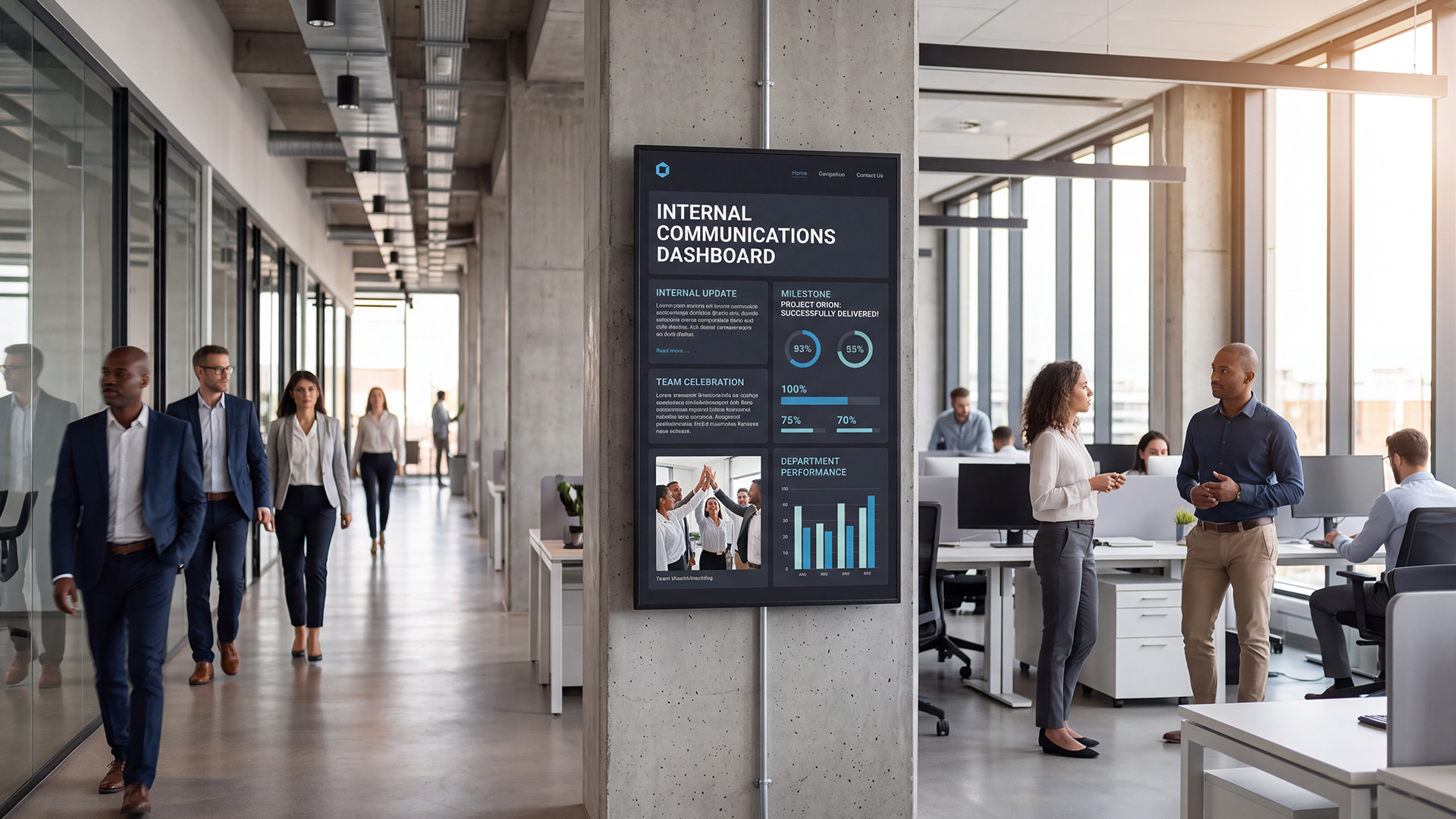
This is exactly the gap enterprise digital signage was built to close.
Why Big Teams Struggle With Internal Communication
Small companies can get away with a lot. A ten-person startup can rely on a group chat and a quick huddle every morning. But once you're managing five hundred employees, or five thousand, across multiple locations and shift patterns, that same approach falls apart.
Think about the layers involved in a mid-to-large enterprise. You've got corporate staff sitting at desks all day with constant access to email and internal tools. You've got frontline or floor staff who might not touch a computer during their entire shift. You've got remote teams working from home. You've got warehouse or manufacturing employees who move around a facility instead of sitting in one spot. Trying to reach all of them with a single method, whether that's email, a printed memo, or a company-wide meeting, almost never works.
The result is what many HR and operations leaders quietly call "communication decay." A message gets sent from leadership, but by the time it filters down through managers, shift leads, and departments, half of it is lost, delayed, or misunderstood. Employees end up hearing about major updates secondhand, sometimes from a coworker, sometimes not at all.
And the cost of that isn't just annoyance. It shows up in missed safety protocols, confused new hires, inconsistent messaging across locations, and a general sense among employees that they're the last to know anything important. That disconnect chips away at trust, and trust is expensive to rebuild.
What Enterprise Digital Signage Actually Solves
Enterprise digital signage isn't just a fancier version of the TV in the break room. When it's done right, it becomes a live, centralized communication layer that spans every physical location a company has, updating in real time from a single dashboard.
Here's what that looks like in practice. An HR team pushes out a benefits enrollment reminder, and it appears instantly on screens in every office, warehouse, and break room across the country, no printing, no forwarding, no waiting for someone to notice an email. A regional manager needs to alert three specific branches about a schedule change, so they target just those screens instead of blasting the whole company. A safety alert needs to go out immediately during an emergency, and instead of relying on a fire alarm and word of mouth, clear instructions appear on every connected display within seconds.
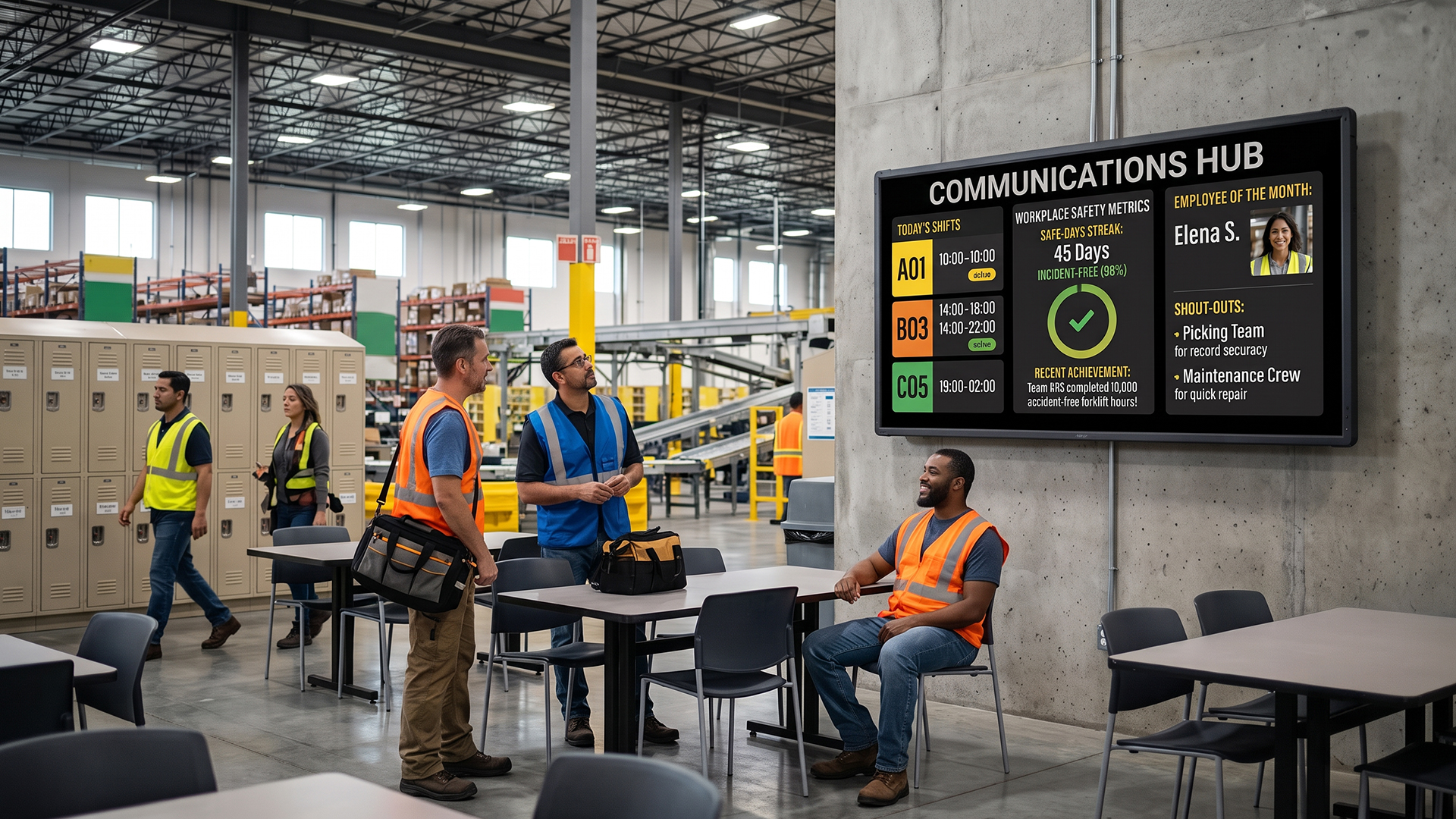
This is the real value of enterprise digital signage: it turns communication from something scattered and reactive into something structured and immediate. Instead of hoping a message reaches people, you know it did, because it's sitting right there on a screen they walk past every day.
For large teams in particular, this matters because maintaining consistency manually becomes almost impossible. When you have twenty locations, you can't count on every manager relaying updates the same way. A centralized screen network removes that dependency. The message leaving headquarters is the exact message every employee sees, whether they're in Ahmedabad or Ohio.
Beyond Announcements: What Enterprise Signage Can Actually Do
It's easy to assume digital signage is just for announcements and welcome messages, but as more enterprises adopt it, a wider range of use cases emerges.
Performance dashboards are a big one. Sales floors, call centers, and warehouses use live screens to display real-time KPIs, keeping teams aware of targets without anyone needing to check a separate reporting tool. Recognition and culture content is another. Employee-of-the-month shoutouts, work anniversaries, and team wins shown on screens do more for morale than most people expect, mostly because they're visible and public rather than buried in an internal newsletter nobody opens.
Then there's onboarding and training support. New hires walking through a facility on day one absorb a surprising amount just from screens displaying safety reminders, company values, or quick how-to content on a loop. It reinforces what they've already been told without anyone having to repeat it constantly.
And during a crisis, whether that's a weather event, an IT outage, or a facility issue, signage becomes a real-time alert system that doesn't rely on people checking their phones. For enterprises with compliance or safety obligations, that's not a nice-to-have. It's often part of meeting a regulatory requirement.
Why This Matters More As Companies Scale
There's a pattern that shows up almost every time a company crosses a certain headcount or number of locations: internal communication starts to feel like it's held together with tape. Leadership assumes messages are getting through. Employees assume someone will tell them if something important happens. And somewhere in that gap, things get missed.
Enterprise digital signage doesn't just patch that gap; it removes the guesswork. Instead of relying on individual managers to remember to pass things along, the system does so automatically, consistently, and instantly.
This also solves a problem that's specific to distributed teams: fragmentation. When every location handles internal updates a little differently, some through email, some through printed notices, some through word of mouth, the company starts to feel disconnected, even if it's technically one organization. A shared digital signage network pulls everything back under one system. Every screen, no matter where it's located, becomes part of the same communication loop.
What to Look For If You're Considering Enterprise Digital Signage
Not all signage platforms are built for enterprise-scale communication, so it helps to know what actually matters when you're evaluating one.
Centralized control is non-negotiable. You need the ability to manage hundreds or thousands of screens from a single dashboard, rather than logging into separate systems for each location. Targeting matters just as much. A good platform lets you send content to specific regions, departments, or individual screens instead of forcing an all-or-nothing broadcast.

Reliability is another factor people underestimate until it fails them. If a screen goes down or an update doesn't sync properly, that's a real-time communication failure, often during an urgent situation. Look for platforms with strong uptime and easy troubleshooting.
Integration capability is worth checking too. The best enterprise signage tools integrate with HR systems, scheduling software, and internal communication platforms, so updates flow automatically rather than requiring manual entry whenever something changes.
And finally, ease of use matters more than most companies expect. If updating a screen requires a design team or an IT ticket, it becomes useless in urgent situations. The people who need to push updates, whether that's HR, operations, or facilities, should be able to do it themselves without a steep learning curve.
Conculsion
Internal communication problems rarely show up as one dramatic failure. They show up as a slow accumulation of missed updates, confused employees, and inconsistent messaging that quietly erodes the sense of connection within the workforce. For large, distributed teams, the traditional tools like email, meetings, and printed notices simply weren't designed to handle that scale.
Enterprise digital signage addresses this by providing companies with a direct, reliable, real-time channel that reaches every employee, everywhere, without relying on someone else to pass the message along. It's not about replacing every other communication tool a company uses. It's about closing the gap those tools can't reach on their own, especially as teams grow beyond the size where informal communication ever really worked in the first place.
For any enterprise with scattered locations, shift-based teams, or a workforce too spread thin for email to reach everyone equally, the question isn't really whether digital signage helps. It's how much time and trust get lost every day it isn't in place.